
Nikola Brežnjak blog - Tackling software development with a dose of humor
  • Home
  • About me
Home
About me
  • Nikola Brežnjak blog
  • Home
  • About me
Books, Programming

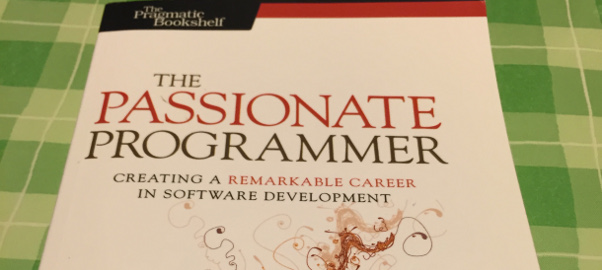
The passionate programmer by Chad Fowler

I rated the book The passionate programmer by Chad Fowler as favorite on my Shelfari account and shortly reviewed it as:

Trully a classic in our field!

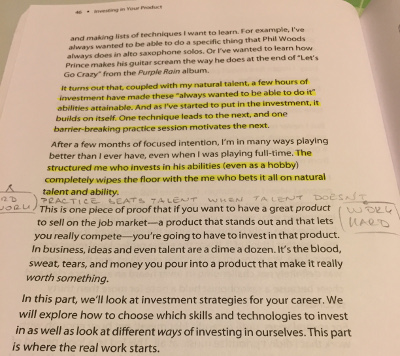
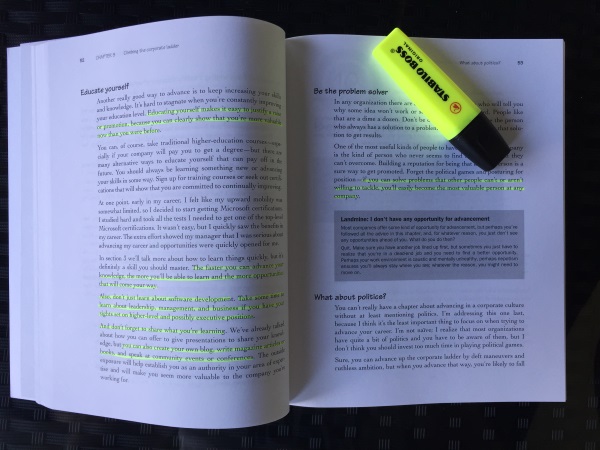
Those of you who have been following my Books category know that I like to mark the passages that I find valuable from books that I read (and somewhere also add my own piece of wisdom 1415131129_smiley-evil), like for example:

ppHardWork

All in all, below are my notes from this book (yes, I know – there are quite a lot of them), and I’m sure a lot of them will resonate with you and I’m sure you’ll want to get a physical copy for yourself  too (if for nothing else, then for doodling on it ;)). Best of all, the book is currently 43% off on Amazon for only $13.58.

I believe that everyone has remarkable in them but that it takes finding something they truly care about to draw it out. You can’t be remarkable if you don’t love your environment, your tools, and your domain.

To become remarkable, you have to believe that you’re making a significant dent in the universe.

Most people spend far more of their waking adulthood working than doing anything else.

If your life is primarily consumed by your work, then loving your work is one of the most important keys to loving your life. Challeng-ing, motivating, rewarding work is more likely to make you want to get up in the morning than dull, average tasks. Doing your job well means that the activity you do for 50 percent of your available time is something you’re good at. Conversely, if you don’t do your job well, a large amount of your time will be spent feeling inadequate or guilty over not performing at your best.

You don’t win a race by trying not to lose.

Kent Beck Extreme programming explained

A person who wants to become great is far more likely to become great than someone who just wants to do their job.

Most people follow everyone else’s plan but their own. To start differentiating yourself, all you have to do is stop and take a good look at your career. You need to be following your plan for you – not theirs.

Businesses don’t exist so we can have a place to go every day. The purpose of a business is to make money.

In The Pragmatic Programmer: From Journeyman to Master, Dave Thomas and Andy Hunt talk about programming by coincidence. Most programmers can relate to the idea: you start working on something, add a little code here, and add a little more there. Maybe you start with an example program that you copy and paste from a website. It seems to work, so you change it a little to be more like the program you really need. You don’t really understand what you’re doing, but you keep nudging the program around until it almost completely meets your needs. The trouble is, you don’t understand how it works, and like a house of cards, each new feature you add increases the likelihood your program will fall apart.

Which technologies should we invest in? Which domain should we develop expertise in? Should we go broad or deep with our knowledge? These are questions we really should be asking ourselves.

Imagine you’ve started a company and you’re developing what is destined to be the company’s flagship product. Without a “hit” with this product, your company is going to go bankrupt. How much attention do you pay to who your target customers are? Before actually manufacturing the product, how much thought do you put into what the product actually is? None of us would let decisions like these be made for us. We’d be completely attentive to every detail of the decision-making process.

So, why is it that most of us don’t pay this kind of attention to the choices we make in our careers? If you think of your career as a business (which it is), your “product” is made up of the services you have to offer. Is demand for your services going to grow or decline over the coming years?

15 years ago COBOL would be a low-rise choice. Low risk low reward. At the time if you invested in Java it would be high risk high reward. BeOS was high risk no reward at the time.

Picking a stable technology that has already wedged itself into the production systems of businesses worldwide is a safer, but potentially less rewarding, choice then picking a flashy new technology that nobody has deployed yet.

Make a list of early, middle, and late adoption technologies based on today’s market. Map them out on paper from left to right; the left is bleeding edge, and the right is filled by technologies that are in their sunsets. Push yourself to find as many technologies in each part of the spectrum as possible. Be as granular as possible about where in the curve they fall in relation to one another. When you have as many technologies mapped out as you can think of, mark the ones that you consider yourself strong in. Then, perhaps, in a different color, mark the ones that you have some experiehce with but aren’t authoritative on. Where are most of your marks on the adoption curve? Do they clump? Are they spread evenly across? Are there any technologies around the far edges that you have some special interest in?

As a .NET programmer, you may find yourself competing with tens of thousands of more people in the job market than you would if you were, for example, a Python programmer. This would result in the average cost of a .NET programmer decreasing significantly, possibly driving demand higher (in other words, creating more .NET jobs). So, you’d be likely to find jobs available, but the jobs wouldn’t pay all that well. If the Python job market were to support noticeably higher prices per programmer, additional people might be attracted to supply their services at this higher price range, resulting in competition that would drive the price back down.

India caters to the already balanced IT services markets. You don’t find mainstream Indian offshoring companies jumping on unconventional technologies. They aren’t first-movers. They generally don’t take chances.

You can’t compete on price, but you can compete on ability.

Research current technical skill demand. Use job posting and career websites to find out which skills are in high demand and in low demand. Find the websites of some offshore outsourcing companies (or talk to employees of those companies if you work with them). Compare the skills available via these companies with the high—demand list you compiled. Make note of which skills appear to be in high demand domestically with little penetration offshore. Do a similar comparison between bleading—edge technologies and the skills available via offshore outsourcing firms. Keep your eyes on both sets of technical skills that are underserved by the offshore companies. How long does it take for them to fill the holes (if ever)? This time gap is the window during which a market imbalance exists.

If you want to stay relevant,you’re going to have to dive into the domain of business you’re in.

Look for industry websites that you can monitor on a regular basis. In both the websites and the magazines, pay special attention to what the big news items and the feature articles are about. What is your industry struggling with? What’s the hot new issue right now? Whatever it is, bring it up with your business clients. Ask them to explain it and to give you their opinions. Think about how these current trends affect your company, your division, your team, and eventually your work.

Be the worst guy in every band you’re in. Being the worst guy in the band means always playing with people who are better than you.

So I learned from this that people can significantly improve its regress in skill, purely based on who they are performing with.

Pick an open source project that you admire and whose developers appear to be at that “next level” you’re looking to reach.

At the time I’d writing, the most popular language is Java, followed by C.

My explanation is that either good people seek out diversity, because they love to learn new things, or being forced into alien experiences and environments created more mature, well-rounded software developers.

For me, as a hiring manager, the first reason is that it shows that you’re interested. If I know you learned something for the sake for the sake of self-development and (better) pure fun, I know you are excited and motivated about your profession.

Learn a new language that makes you think in a new way.

Thinking about not losing is not the way to win! Winners take risks. They think about where do you want to go – not where the rest of the pack is.

But if your job isn’t fun, as we’ve come to realize, you don’t do a fantastic job at it.

More of us understand action leads to excellence. And without fun, there’s unlikely to be any passion in a software job.

Staying in the single company, working your way up the ranks, easily would think environment in which to grow as a developer. Gone are the days of the life for who would join a big company and settle in for a full career. This sort of behavior used to be assigned of the dictation. No it’s a liability. If you work in only one place and seen one set of systems, many [smart] managers would see that as a strike against you when making hiring decisions. I personally rather hire someone who has seen the variety of successes and failures in different environments than someone who has known only one way of doing things.

Programmer geeks can’t lead, and leaders can’t hack. It’s rare to find someone who’s even decent both.

Unfortunately, the software industry has turned out a whole lot of these shallow specialists who use the term specialist as an excuse for knowing only one thing.

This guy wanted to build his career around a specific technology created by a specific company of which he was not an employee. What if the company goes out of business? What if it let its now-sexy technology become obsolete? Why would you want to trust a technology company with your career?

The professional services barrier is the artificial barrier that a company erects between you and the solution to a problem you may have so that it can profit from selling you support services. Sometimes this barrier is intentionally erected, and sometimes it’s erected as a side effect of the attempt the company makes to protect its intellectual property (by not sharing its source code).

Try the small project, twice. Try it once in your home-based technology and then once, as idiomatically as possible, in the competing technology.

You have to be passionate about your work if you want to be great at your work. If you don’t care, it will show.

It turns out that, coupled with my natural talent, a few hours of investment have made these ”always wanted to be able to do it” abilities attainable. And as I’ve started to put in the investment, it builds on itself. One technique leads to the next, and one barrie-breaking practice session motivates the next. The structured me who invests in his abilities (even as a hobby) completely wipes the floor with the me who bets it all on natural talent and ability.

Lao Tzu said, ”Give a man a fish; feed him for a day. Teach a man to fish; feed him for a lifetime.” That’s all well and good. But Lao Tzu left out the part where the man doesn’t want to learn how to fish and he asks you for another fish tomorrow. Education requires both a teacher and a student.

Don’t ask to be taught, learn for yourself!

You can creatively help a business until you know how it works.

Depending on others is often seen as a sign of weakness.

It’s better to be moving in one direction than to be sitting still.

Important thing is that he narrowed down the long list of skills I could be learning to the short list of skills I learned.

If you want to really learn something, try teaching it to someone.

You don’t have to set up a formal mentoring relationship to get these benefits. Just start helping people, and the rest will come naturally.

If you always sound good during practice sessions, it means you’re not stretching your limits.

Important thing is to find your practice needs and to make sure you’re not practicing during your performances [on the job]. You have to make time for practice. It’s your responsibility.

codekata.com

Even with the abundance of prescriptive methodologies to choose from, it’s not likely you will ever work for a company that fully implement any of them. That’s OK. The best process to follow is the one that makes your team most productive and results in the best products.

Studying the work of masters is in the central part of becoming a master.

If you can hear the music or see the piece of art, you can learn from it. Thankfully, as a soft for developers we have access to practically infinite array of existing software in the form of open source software.

Sir Isaac Newton said, “If I have seen further, it’s by standing on the shoulders of giants.”

The standard IT management answer is that you add programmers to go faster. It’s wrong, but that’s what people believe.

Unless you’re really lucky, you’re probably not getting paid to be smart.

We are being paid to create value.

To be successful, wrong ability will get you only so far. The final stretch is populated by closures – people who finish things. This means getting up out of our reading chairs and getting things done.

Work expands so to fill time available for its competition.

Sense of urgency, even if manufactured, is enough to easily double or triple your productivity.

Always be the one to ask, “But, what can we do right now?”

It seems backward, but keeping your mind focused on the present will get you further toward your goals than keeping your mind focused on the goal itself.

Why is that, without facing great pressure, we are often able to work ourselves into this kind of altruistic, ultra productive frenzy.

How much more fun with your job be if you could treat the most interesting and annoying tasks with the same feverish desire to do them right?

It’s easy to get into the mode of just wanting more. It unfortunately seems to be a basic human tendency, in fact. You get the salary increase, and it feels good for a little while, but then you’re thinking about the next one.

Ask, “Was I worth it today?”

A dollar today is worth more than a dollar next year, because a dollar today can be used to generate more dollars.

You should never get too comfortable.

The less replaceable you think you are, the more replaceable you are.

Everyone likes creating. That’s when we feel we are given the opportunity to really put our stamp on a piece of work. To feel like we own it.

If l give you $1,000 and ask you to go get me a cup of coffee, I’m going to be very unhappy if you return with 1,000 less dollars and no cup of coffee. I’m even going to be unhappy if you bring me plenty of really nice coffee but it takes you two hours. If I give you $0 and ask you to go get me a cup of coffee, I’ll be extremely appreciative if you actually return with the coffee, and I’ll be understanding if you don’t. Project work is like the first scenario. Maintenance is like the second.

Martin renamed 40 hour work week to 8 hour burn.

When it comes to work less really can be more. The primary reason cited by the extreme programmers is that when we are tired we can’t think as effectively as when we are rested. When we are burned out, we aren’t as creative, and the quality of our work reduce his dramatically. We start making stupid mistakes that end up costing us time and money.

Projects are marathons not sprints.

Though your short-term productivity will significantly increase as you start putting in the hours, in the long term you’re going to crash so hard that the recovery time will be larger than the productivity gains you enjoy during your 80 hour weeks.

Apparently, when money was scarce, I found ways to be more efficient with my cash. And, the end result was essentially the same.

Bob Martin’s eight hour burn places the constraint on you and gives you a strategy for dealing with that constraint. You get to work and think, I’ve only got eight hours!

As thought workers, even if we’re not in front of a computer or in the office, we can be working. You might be working while you’re driving to dinner with your spouse or while you’re watching a movie. Your work is always around nagging you.

Make sure you sleep well tonight. Tomorrow, eat breakfast and then start work at an exact time [preferably a little earlier than usual]. Work on it for four hours. Take an hour lunch. Then work for four more hours so intensely that you’re absolutely exhausted and can’t do anymore work. Go home, relax, and have fun.

A problem needs resolution. Lingering on who’s fault it is only prolongs the issue.

The quickest path to missing your commitment is to make commitments that you know you can’t meet. I know that sounds patently obvious, but we do it every day. We are put on the spot and we don’t want to disappoint our leaders, so we agreed to impossible work being done in impossible timelines.

Heroes never panic.

We panic because we lose perspective. When something is going wrong, it’s hard not to focus all attention on the problem. To some extent, that’s a good way to solve problems. Unfortunately, it also makes the problem, no matter how small, see more important than it is. And with the problem inflated and stress level running high, our brains turn themselves off.

So, here’s how I’m learning to not panic. When something bad happens and I start to feel that sinking, stressed-out feeling that leads to panic, I compare myself to the frustrated computer-illiterate, and I laugh at myself. I analyze the situation from the third—person perspective, as if I’m helping that frustrated family member with their word processing disaster. Seemingly hard problems are suddenly easier. Seemingly bad situations are suddenly not so bad. And, I often find that the solution simple and staring me in the face in the same way that an error dialog often tells you exactly what to do next. If you’d just have the presence of mind to read the error message, the problem might be solved.

Like families, successful projects are alike, but they become successful project fails in its own way.

In short, you may have the best product in history, but if you don’t do some kind of advertising, nobody’s going to buy it.

These managers and customers we are talking about have a dirty little secret: they are afraid of you. And for a good reason. You’re smart. We speak a cryptic language they don’t understand. You make them feel stupid with your sometimes sarcastic comments [which you might not have even intended to be sarcastic]. And, your work often is the last and most important toll gate between the projects conception and it’s birth.

Wouldn’t you want to hire the person who wrote the book and technology or methodology you’re attempting to deploy?

You will never feel 100% ready, so might as well start now.

Anyone can use Rails. Few can say Rails contributor.

Don’t just mastered the subject – write the book on it. Write code generators that take what used to be a one week process took a five minute process. Instead of being respected among your coworkers, become your cities most recognizable authority on whatever technologies you’re focusing on by doing seminars and workshops. Do something previously unthinkable on your next project.

Carve out weekly time to investigate the bleeding edge. Make room for at least two hours each week in order to research and get the colleges and to start develop skills in them.

The next time you have to wash the dishes, don’t wash them to get them done. Try to enjoy the experience of washing the dishes. Don’t focus on finishing them. Focus on the act of washing them itself.

Watch the alpha geeks.

If you’re constantly exposed to something, it’s hard to see it changing unless change happens rapidly.

Developer, review thyself.

Start keeping a journal. It could be a blog or a personal diary. Write about what you’re working on, what you’re learning, and your opinions about the industry. After you’ve been keeping the journal for sometime, reread old entries. Do you still agree? Do they sound knees? How much have you changed?

Make your improvements small and incremental but daily.

I highly recommend that you check out the book Soft Skills by John Sonmez if you liked this post, as you’ll find even more great content about how to become the best software developer version of yourself.

Books

Spell or high water – Scott Meyer

My notes from a book Spell or high water by Scott Meyer, which I rated 4/5 on my Shelfari account and which I think every programmer will enjoy. Bash scripts, hidden files, root access, you’ll love it 🙂

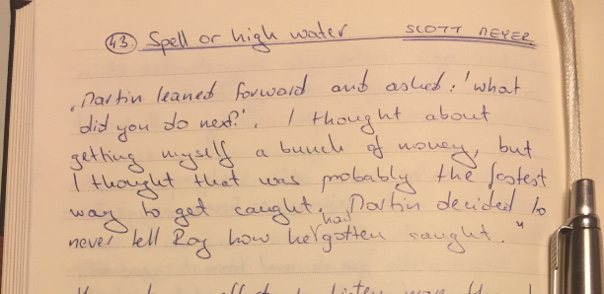
Martin leaned forward and asked what did you do next? I thought about getting myself a bunch of money, but I thought that was probably the fastest way to get caught. Martin decided to never tell Roy how he had gotten caught.

He made an effort to listen more than he talked, which doesn’t come naturally when you seem older than everyone around you by at least 20 years.

Did that sentence made sense when you planned it in your head, or do you just open your mouth and let the words fall out however they like?!

Is killability even the word? If I use it and you know what it means, it’s a word.

Imagine if you could introduced an atheist to God. Will the atheist find religion, or would he find the reasons to disbelieve the evidence of his own eyes?

You make more mistakes because you try more things than they do.

For a smart person to argue with the dumb person they have to dumb down their logic on the fly, while the dumb person thinks in dumb logic naturally, giving them an advantage.

There’s nothing showoff hates more then a competing showoff.

The audience expects us to fool them. They don’t think the magician can really do magic. They come to be entertained by a lie.

My notes from a #book every #programmer will love: Spell or high water by Scott Meyer http://t.co/5Bifx7WjVE

— Nikola Brežnjak (@HitmanHR) September 7, 2015

Books

Father Forgets – W. Livingston Larned

I stumbled across this rather touching poem Father Forgets by W. Livingston Larned when I was reading the book How to win friends and influence people by Dale Carnegie (you can see my favorite quotes from that book here), and indeed it’s something one should sit down and think about from time to time, if one has kids of his own…

Here’s the full poem Father Forgets by W. Livingston Larned:

Listen, son; I am saying this as you lie asleep, one little paw crumpled under your cheek and the blond curls stickily wet on your damp forehead. I have stolen into your room alone. Just a few minutes ago, as I sat reading my paper in the library, a stifling wave of remorse swept over me. Guiltily I came to your bedside.
There are things I was thinking, son: I had been cross to you. I scolded you as you were dressing for school because you gave your face merely a dab with a twoel. I took you to task for not cleaning your shoes. I called out angrily when you threw some of your things on the floor.
At breakfast I found fault, too. You spilled things. You gulped down your food. You put your elbows on the table. You spread butter too thick on your bread. And as you started off to play and I made for my train, you turned and waved a hand and called, “Goodbye, Daddy!” and I frowned, and said in reply, “Hold your shoulders back!”
Then it began all over again in the late afternoon. As I came up the road, I spied you, down on your knees, playing marbles. There were holes in your stockings. I humiliated you before you boyfriends by marching you ahead of me to the house. Stockings were expensive – and if you had to buy them you would be more careful! Imagine that, son, form a father!
Do you remember, later, when I was reading in the library, how you came in timidly, with a sort of hurt look in your eyes? When I glanced up over my paper, impatient at the interruption, you hesitated at the door. “What is it you want?” I snapped.
You said nothing, but ran across in one tempestuous plunge, and threw your arms around my neck and kissed me, and your small arms tightened with an affection that God had set blooming in your heart and which even neglect could not wither. And then you were gone, pattering up the stairs.
Well, son, it was shortly afterwards that my paper slipped from my hands and a terrible sickening fear came over me. What has habit been doing to me? The habit of finding fault, of reprimanding – this was my reward to your for being a boy. It was not that I did not love you; it was that I expected too much of youth. I was measuring you by the yardstick of my own years.
And there was so much that was good and fine and true in your character. The little heart of you was as big as the dawn itself over the wide hills. This was shown by your spontaneous impulse to rush in and kiss me good night. Nothing else matters tonight, son. I have come to your bedside in the darkness, and I have knelt there, ashamed!
It is a feeble atonement; I know you would not understand these things if I told them to you during your waking hours. But tomorrow I will be a real daddy! I will chum with you, and suffer when you suffer, and laugh when you laugh. I will bite my tongue when impatient words come. I will keep saying as if it were a ritual: “He is nothing buy a boy – a little boy!”
I am afraid I have visualized you as a man. Yet as I see you now, son, crumpled and weary in your cot, I see that you are still a baby. Yesterday you were in your mother’s arms, your head on her shoulder. I have asked too much, too much.
There’s also a video on YouTube:
https://www.youtube.com/watch?v=Gig8KkpsWvI
Books

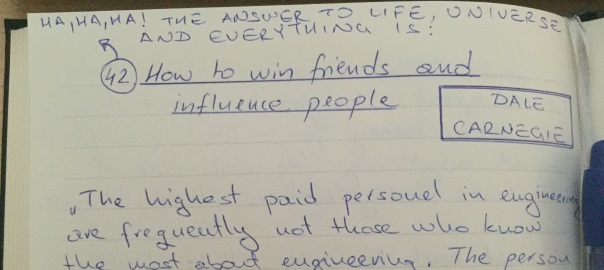
How to win friends and influence people – Dale Carnegie

My notes from a classic How To Win Friends and Influence People by Dale Carnegie, which I rated 5/5 on my Shelfari account and put to my all time Favorites list. What’s so great about this book is that it gives the real word examples so that you can try and implement them in your day to day life.

Here are my favorite quotes from this book, and hope you get a tip or two on how to win friends and influence people 🙂

The highest paid personel in engineering are frequently not those who know the most about engineering. The person who has technical knowledge plus the ability to express ideas, assume leadership and to arouse enthusiasm among people – that person is headed for higher earning power.

The ability to deal with people is as purchasable commodity as coffee.

Health is the prime interest of adults. Next interest is people; how to understand and to get along with people, how to make people like you and how to win others to your way of thinking.

Judge Not Lest Ye Be Judged!

Don’t complain about the snow under your neighbors roof, while your own doorstep is unclean.

I will speak ill of no man, and speak all the good I know of everybody.

Any fool can criticize, condemn and complain, and most fools do; it takes character, and self-control to be understanding and forgiving.

A great man shows his greatness by the way he treats little men.

To show you I’m sure you’ll never do this again I want you to service my F 51 tomorrow.

I consider my ability to arose enthusiasm among my people, said Charles Schwab, the greatest asset that I possess.

The way to develop the best in the person is by appreciation and encouragement.

Father forgets – W. Livingston Larned

Criticism from superiors kills ambition.

We often take our spouses so much for granted that we never let them know that we appreciate them.

I can’t think of six things I would like to change about you – I love you the way you are.

If there is any one secret of success, it lies in the ability to get the other persons point of view, and see things from that person’s angle, as well as from your own.

Arouse in the other person an eager want. He who can do this has the whole world with him, he who does not walks a lonely way.

You can make more friends in two months by becoming genuinely interested in other people then you can into years trying to get other people interested in you.

Most folks are happy as they make their minds to be.

There is nothing either good or bad, but thinking makes it so.

Listening intently and be genuinely interested in another people stories and they will love you for it, because they just want to tell their story and you can actually learn a thing or two from we won.

Always make the other person feel important.

What was I trying to get out of him? If we are so contemptively selfish that we can’t radiate a little happiness and pass on a bit of honest appreciation without trying to get something out of it in return, if our souls are no bigger than sour crab apples, we should meet with the failure we so richly deserve.

I wanted something priceless. I got the feeling that I’ve done something for him being done anything whatever in return for me.

Do onto others, as you would have others do onto you.

6 ways to make people like you:

  • become genuinely interested in other people
  • smile
  • person’s name is the most important sound to that person in any language
  • be a good listener – encourage others to talk about them selves
  • talk in terms of the other person’s interest
  • make the other person feel important

If you’re wrong admit it quickly and emphatically.

…the sun then told the wind that gentlenessand friendliness were always stronger than fury and force.

He who treads softly goes far.

If te work is exciting and interesting the worker looks forward to do it and it’s motivated to do a good job.

Win people to your way of thinking:

  • the only way to get the best of an argument is to avoid it
  • show respect for other people’s opinions, never say “you’re wrong”
  • if you’re wrong admit it quickly and emphatically
  • begin in a friendly way
  • get the other person saying YES YES immediatelly
  • let the other person do a great deal of talking
  • let the other person feel the ideas is his or hers
  • try honestly to see things from other person’s point of view
  • be symphatetic with other person’s ideas and desires
  • appeal to the nobler motives
  • dramatise your ideas
  • throw down a challenge

Praise is like sunlight to the warm human spirit. We can not flower and grow without it, and yet while most of us are too ready to apply to others the cold wind of criticism, we are somehow reluctant to give our fellow warm sunshine of praise.

Effective leader keeps this in mind:

  • be sincere, don’t promise anything that you can’t deliver
  • forget about your benefits and concentrate on the benefits of other person
  • know exactly what you want the other person to do
  • be emphatetic – ask yourself what it is the other person really wants
  • consider the benefits that person will receive from doing what you suggest
  • match those benefits to the other person’s wants
  • when you make your request put it in a form that will convey to the other person that he personally will benefit

Be a leader who often changes people’s attitudes and behavior. Some suggestions to accomplish this:

  • begin with praise and honest appreciation
  • call attention to peoples mistakes indirectly
  • talk about your own mistakes before criticising the other person
  • ask questions instead of giving direct orders
  • let the other person save face
  • praise the slightest improvement and praise every improvement
  • be harthy in your approbation and lavish in your praise
  • give the other person a fine reputation to live up to
  • use encouragement, make the fault easy to correct
  • make the other person happy doing the thing you suggest
Books

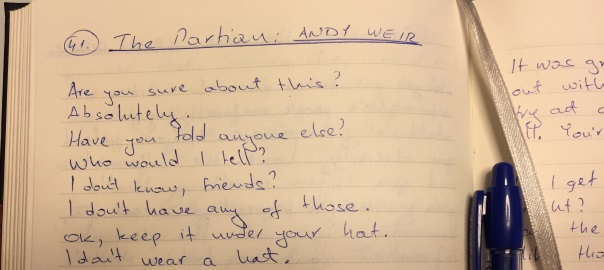
The Martian – Andy Weir

My notes from a best seller book The Martian by Andy Weir, which I rated 4.4/5 on my Shelfari account. The book was made into a movie, starring Matt Damon (you can see the trailer I linked at the bottom of the post), and it’s expected to come out in October this year. I think Matt Damon is an awesome choice for the main character!

Here are my favorite quotes from this book:

Are you sure about this?
Absolutely.
Have you told anyone else?
Who would I tell?
I don’t know, friends?
I don’t have any of those.
OK, keep it under your hat.
I don’t wear a hat.
It’s just an expression.
Really? It’s a stupid expression.
You’re being difficult.
Ah, thanks.

Being your backup has back-fired. I guess NASA figured botany and chemistry are similar because they both end in Y.

You started my training by buying me a beer. For breakfast.

Why is my daughter in space? You were always scientifically minded. It was great. Straight A student. Hanging out with nerdy guys, too scared to try out anything. No wild side at all. You’re every father’s dream daughter.

If I get back to Earth, I’ll be famous, right? A fearless astronaout that beat all the odds, right? I bet women like that. More motivation to stay alive.

Official video trailer for The Martian:

Books

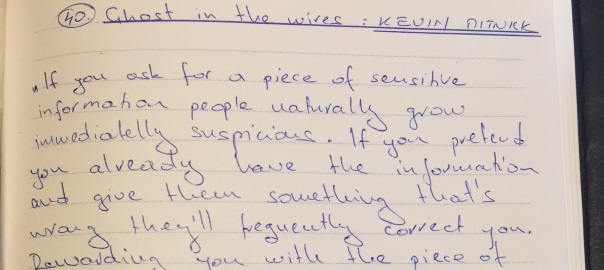
Ghost in the Wires – Kevin Mitnick

My notes from an awesome book Ghost in the Wires by Kevin Mitnick, which I rated 5/5 on my Shelfari account:

If you ask for a piece of sensitive information people naturally grow immediatelly suspicious. If you pretend you already have the information and give them something that’s wrong they’ll frequently correct you. Rewarding you with the piece of information you were looking for.

Freedom downtime documentary

Free Kevin movement

Movie Takedown – Kevin says it’s full of crap

Kevin Mitnick Voice Mail and Fax Exploit

Guest on the TV show Alias with Jennifer Garner

The Art of Deception book

Books

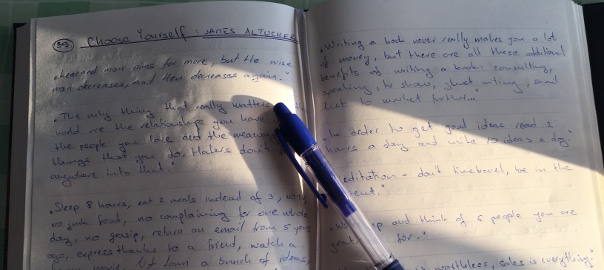
Choose Yourself! – James Altucher

My notes from the book Choose Yourself! by James Altucher:

Learned man aims for more, but the wise man decreases, and then decreases again.

The thing that really matters in this world are relationships you have with people you love and meaningful things that you do. Haters don’t fit anywhere into that.

  • Sleep eight hours
  • Eat two meals instead of three (I don’t agree with this one personally smileyGlasses)
  • No TV
  • No junk food
  • No complaining for one whole day
  • No gossip
  • Return an email from five years ago
  • Express thanks to a friend
  • Watch a funny movie
  • List down a bunch of ideas
  • Read spiritual text
  • Say to yourself in the morning “I’m going to save a life today”
  • Pick up a hobby
  • Surprise someone
  • Think about five people you’re grateful for
  • Forgive someone – write it on a paper and burn it
  • Take the stairs
  • Don’t see yes when you think no
  • Tell someone you love them
  • Deep breathing

After a certain salary point, your marginal happiness doesn’t go up.

Writing a book never really makes a lot of money, but there are all these additional benefits of writing a book: consulting, speaking, TV shows, ghost writing, email list to market further. 

In order to get good ideas read two hours a day and write ten ideas a day.

Wake up and think of five people you’re grateful for.

Meditation – don’t time travel, be in the present.

Negotiation is worthless, sales is everything.

Better to sell early than to go broke.

Simple effort will give you a customer for life – always give a little extra. 

If you love something you get knowledge, the contacts, you’ll build something nobody else has, you’ll wow the customers.

… and that’s Stephen King – all it took was a few weeks of not writing to fall completely off his game even though he’s one of the best in the world at what he does.

The idea muscle has to be exercised daily.

Activate another part of your brain. Best ideas come from collision between  newer  and older ideas. Take two older, unrelated ideas and make them have sex.

Perfectionism may harm you. Embrace failure and get ASAP on your feet again.

Delegate jobs to someone else.

If you can’t help yourself you won’t be able to help others.

Be physically, emotionally, spiritually and mentally healthy.

Books

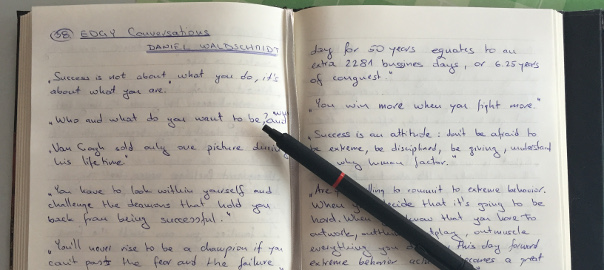
EDGY Conversations – Dan Waldschmidt

My notes from an awesome book EDGY Conversations by Dan Waldschmidt, which I rated 5/5 on my Shelfari account:

Success is not about what you do, it’s about what you are.

Who and what do you want to be, and why?

Van Gogh sold only one picture during his lifetime.

You have to look within yourself and challenge the demons that hold you back from being successful.

You’ll never rise to be a champion if you can’t pass the fear and the failure and the excuses holding you back.

You have to believe that you can be amazing regardless of where or who you are right now.

Carl Sugarfoot Joseph

Simply getting up one hour earlier a day for 50 years equates to an extra 2281 business days, or 6.25 years of conquest.

You win more when you fight more.

Success is an attitude: don’t be afraid to be extreme, be disciplined, be giving, understand the why human factor.

Are you willing to commit to extreme behavior? When you decide that it’s going to be hard. When you know that you have to outwork, outthink, outplay, outmuscle everything you do from this day forward extreme behavior actually becomes a great way to focus what you do.

Small jump forward is actually a big leap backwards.

You want harmony, not balance.

People really want to believe effort is a myth. I think we’ve been tricked by the few lucky people on the top of the heap. We see the folks who managed to get by and it’s easy to forget that these guys are the exceptions. For everyone else effort is directly related to success. You don’t get to choose luck, effort on the other hand is available there all the time.

Jerry Rice

Only limits that exist are the ones in your head.

With discipline and effort you can do just about anything.

The average age of a successful interpreter is mid 40s.

Effort is more than ‘if you pay me more, I’ll work harder’, it’s about not cheating yourself out of your potential.

Cliff Young

Passion is the antidote to the setbacks you will surely face on the way to success. It’s that often illogical passion and emotion that allows you to keep going long after it makes sense. When you put enough of yourself into something you will do whatever it takes to come out as a winner.

Anyone can conquer when the odds are in their favor. The challenge is to do what it’s hard and the noble and the right when you are sick and tired and tired and sick.

It takes discipline to keep moving forward.

It’s not only what you’re willing to do what will make you successful, it’s also what you’re willing to do without, until you get there.

You may spend a decade of sleepless nights until you make it to the finish line – and you need to plan for that.

Plan to work harder than you ever imagined possible. And then, double that effort!

Your plan should be bigger than simply “not losing”.

Have a giving mindset.

Success and living in balance life should not be in the same sentence.

Give expecting nothing in return, and you will change people’s lives.

Marianne Williamson: “Our deepest fear is not that we are inadequate. Our deepest fear is that we are powerful beyond measure. It is our light, not our darkness, that most frightens us. We ask ourselves, who am I to be brilliant, gorgeous, talented, fabulous? Actually, who are you not to be? You are a child of God. Your playing small doesn’t serve the world. There’s nothing enlightened about shrinking so that other people won’t feel insecure around you. We are all meant to shine, as children do. We were born to make manifest the glory of God that is within us. It’s not just in some of us; it’s in everyone. And as we let our own light shine, we unconsciously give other people permission to do the same. As we’re liberated from our own fear, our presence automatically liberates others.”

Derek Redmond

Brain handling new information: If it’s boring or expected, brain ignores it. If it’s too complex, the brain dramatically summarizes it. If it’s threatening it prepares for “fight or flight” scenario.

What do you think about most is what you become. You are today who you thought you would be. You will be in the future who you think you want to be today.

Everything in life starts with your thinking. If you let fear drive your thoughts, you’ll never do the things that lead to success. You’re actually a lot stronger than the fear in your mind lets you think you are.

If you want to dominate, control your thoughts.

Successes is what you decide it is, not what other people tell you it should be. You decide what is right for you.

You,  believe in you…

Books

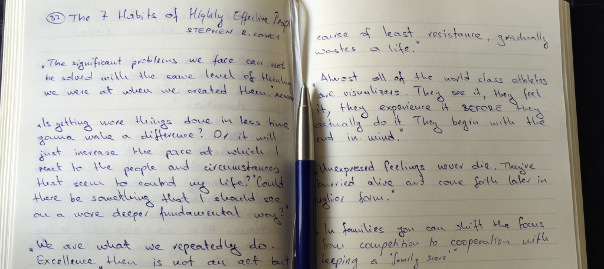
The 7 Habits of Highly Effective People – Stephen Covey

My notes from the book The 7 Habits of Highly Effective People by Stephen Covey:

The significant problems we face can not be solved with the same level of thinking we were at when we created them – Albert Einstein

Is getting more things done in less time gonna make a difference? Or it will just increase the pace at which I react to the people and circumstances that seem to control my life? Could there be something that I should see on a more deeper fundamental way?

We are what we repeatedly do. Excellence then is not an act but a habit – Aristotle

“The work will come again, but childhood won’t”, said the father when he was called to work and previously he arranged to go to zoo with his children.

Too much undisciplined leisure time in which a person continually takes a course of least resistance gradually wastes a life.

Almost all of the world class athletes are visualizers. They see it, they feel it, they experience it before they actually do it. They begin with an end in mind.

Unexpressed feelings never die. They’re buried alive and come forth later in uglier form.

In families you can shift the focus from competition to cooperation with keeping a ‘family score’.

Like a body – television is a good servant but poor master.

And finally, the habits:

  • Be proactive
  • Begin with an end in mind
  • Put first things first
  • Think win-win
  • Seek first to understand, then to be understood
  • Synergize
  • Sharpen the say
CodeProject, Programming

Soft Skills: The Software Developer’s Life Manual by John Sonmez

[18.09.2015] edit: I honestly can’t believe it! This awesome book is now also available as an audiobook! Now I’ll be able to listen to this ever so slightly awesome content even in my car! John Sonmez, congratulations!, this is probably the first ever programming related book to be published as an audiobook!

positiveFeedback

I reviewed the book Soft Skills: The Software Developer’s Life Manual by John Sonmez with 5 stars on Amazon with the following comment:

I believe Soft Skills will indeed become every software developers’ life manual, in a similar way as Code Complete 2 is.

I really enjoyed the book, and am recommending it to all my “IT” friends (just lent it today to a co-worker :)) – John Sonmez really poured his whole life experience into this, and for this I thank him since I think we all have something to learn from a man who made almost 50 courses for Pluralsight, wrote a bestseller, retired at 33, was a fitness model, bodybuilding contestant, and who is, well, just pure awesome. Btw, I also found that he’s damn speedy in answering any emails, so kudos for not being a hot headed superstar author as some these days play out to be.

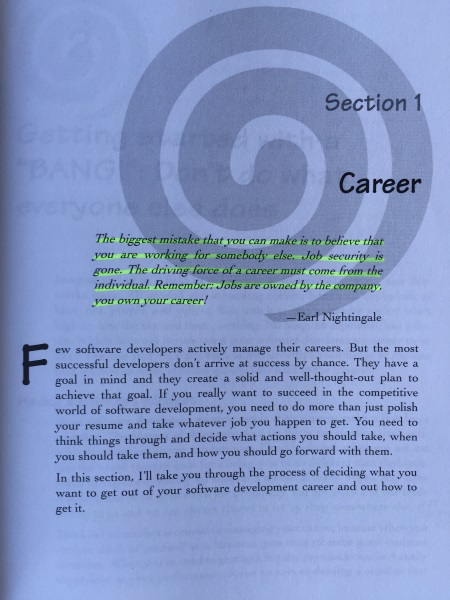
The book is divided in 7 chapters, and it’s packed with awesome content. Those of you who have been following my Books category know that I like to mark the passages that I find valuable from books that I read, like for example:

SoftSkills_highlights

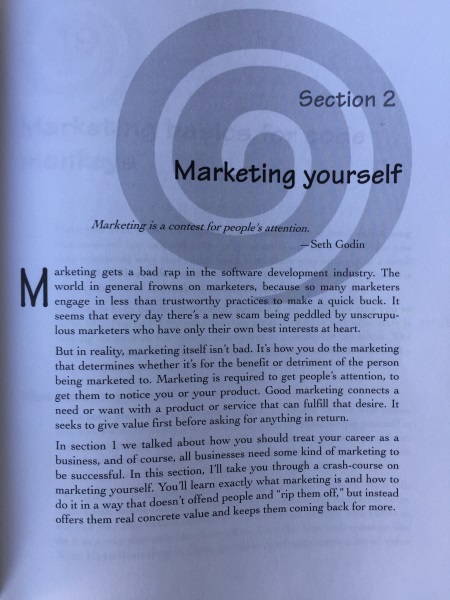
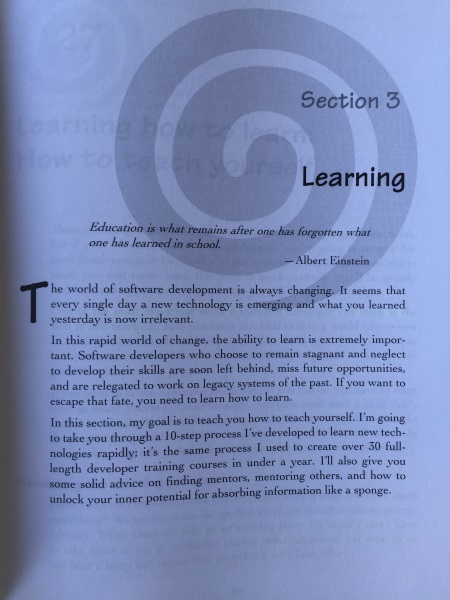
but here I won’t be putting them online since that would be a whole lot portion of the book, and I don’t want to be chased for some copyright issues smileyGlasses. Instead I’ll just show you the images of the chapters and comment a bit about them.

In the first section John talks about topics concerning ones career and steps to take in order to make the most out of it. Topics ranging from how to hack the interview, how to actually set goals, work as a freelancer, and even how to quit your job.

1

In the second section John talks about how to create your blog as a first thing you should do to start marketing yourself. John also has a free email course on how to build a successful blog, so make sure to get that free resource if you’re into starting your own blog, or increasing the views of your existing one.

2

In the third section John talks about why is continuous learning something you signed up for the minute you decided to make programming your calling. Also, he explains his own 10-step process for learning, which he used to learn and produce almost 50 courses on Pluralsight.

3

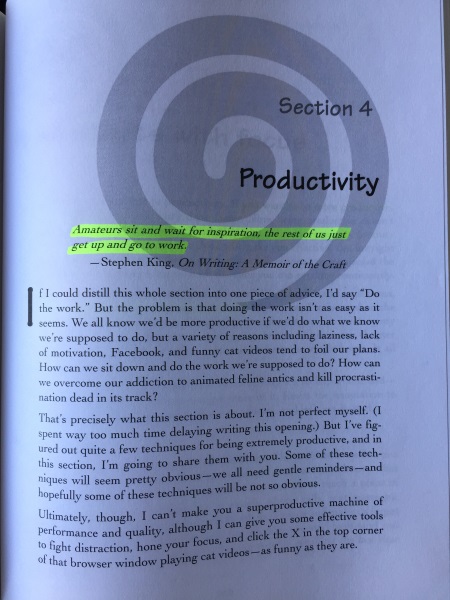
In fourth section John talks about methods and techniques he uses in order to stay crazily productive as he is. Few of them are KanbanFlow and Pomodoro technique.

4

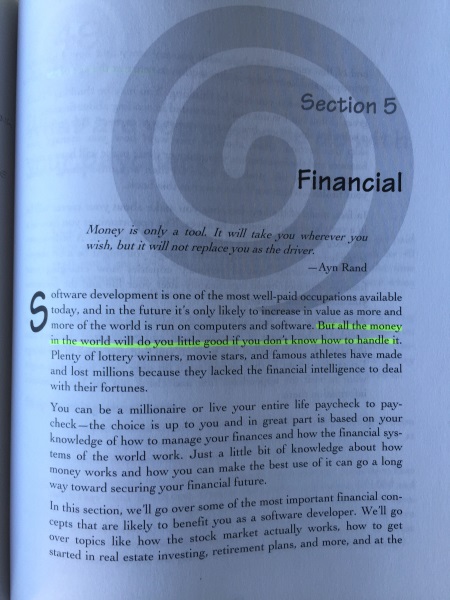
In the fifth section John shares his own method of how he retired at the age of 33. He seems to be highly influenced by authors such as Robert Kiyosaki, and you can see my notes from his book Rich Dad Poor Dad.

5

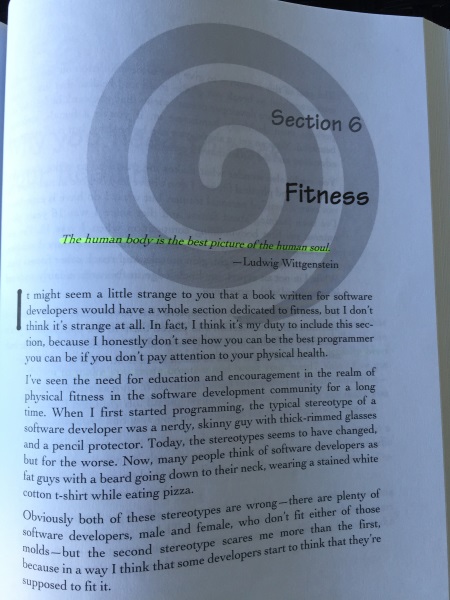
In sixth section John talks about the importance of fitness in developers life as a tool for increased productivity and better well-being. Also, he covers few of the tech gear for geeks like me (I love my FitBit).

6

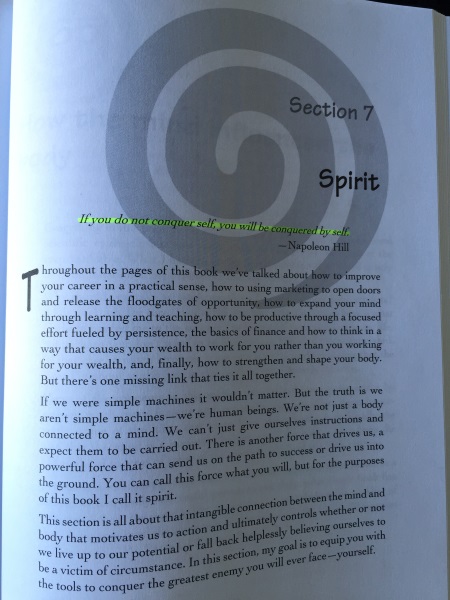
Section seven is all about having the right mental attitude, and I’ll quote one of my favorite authors, Napoleon Hill: “You can do it if you believe you can”. If you’re interested, you can read more Napoleon Hill quotes from my notes from his book Think and Grow Rich.

7

After the book I went on to check out his http://simpleprogrammer.com blog, and what’s awesome is that he gives a free email course on how to build a successful blog. Am currently on week 5, and am really learning some key things on what one should do in order to increase his blog credibility and, well, views. So, hope to see those 100k+ users monthly soon 😉

Page 8 of 12« First...«78910»...Last »

Recent posts

  • FOMO as a Developer: You’re Not Behind, You’re Just Human
  • If only life had an XP bar
  • Are Book Summaries Worth It?
  • Book review: 5 Love Languages
  • Why You Should Start Blogging (Even If Nobody Will Read It)

Categories

  • Android (3)
  • Books (115)
    • Programming (22)
  • CodeProject (36)
  • Daily Thoughts (78)
  • DevThink (8)
  • Go (3)
  • iOS (5)
  • JavaScript (128)
    • Angular (4)
    • Angular 2 (3)
    • Ionic (61)
    • Ionic2 (2)
    • Ionic3 (8)
    • MEAN (3)
    • NodeJS (27)
    • Phaser (1)
    • React (1)
    • Three.js (1)
    • Vue.js (3)
  • Leadership (1)
  • Meetups (8)
  • Miscellaneou$ (84)
    • Breaking News (8)
    • CodeSchool (2)
    • Hacker Games (3)
    • Pluralsight (7)
    • Projects (2)
    • Sublime Text (2)
  • PHP (6)
  • Quick tips (44)
  • Servers (8)
    • Heroku (1)
    • Linux (3)
  • Stack Overflow (82)
  • Unity3D (9)
  • VibeCoding (2)
  • Windows (8)
    • C# (2)
    • WPF (3)
  • Wordpress (2)

"There's no short-term solution for a long-term result." ~ Greg Plitt

"Everything around you that you call life was made up by people that were no smarter than you." ~ S. Jobs

"Hard work beats talent when talent doesn't work hard." ~ Tim Notke

© since 2016 - Nikola Brežnjak