
Let’s talk about improving one’s memory…
No, not the RAM kind. Sadly, no extra gigabytes for your brain today 🤷♂️
The fun part? A lot of what looks like "wow, this person is a genius" is actually technique, practice, and a few surprisingly simple mental tricks. Here you’ll learn about practical methods like chaining, memory palaces, and the person-action-object system.
You can listen to the podcast episode that sparked this post: DevThink Episode 004 – Memory
The big idea: memory is trainable
One of the most encouraging takeaways from this conversation is that memory is not some fixed trait that only a lucky few are born with.
Sure, some people seem naturally better at remembering names, lists, dates, or card sequences. But the techniques discussed in the episode make a strong case for something much more useful: memory can be improved on purpose.
And that’s good news, because it means you don’t have to wait for talent to show up. You can work on it. 💪
Why weird works
A theme that keeps coming up in the episode is this: normal things are forgettable, weird things stick.
If you try to remember "milk" by imagining a carton of milk, your brain shrugs and moves on.
But if you imagine milk exploding out of your mailbox like a tiny dairy waterfall 😂, now we’re talking.
That’s because vivid, strange, emotional, exaggerated images are easier to remember than plain abstract words. Our brains are much better at holding onto images and stories than isolated bits of information.
This is why so many memory systems work: they convert boring information into visual nonsense. Beautiful, useful nonsense.
Technique #1: Chaining
This is probably the easiest technique to try immediately.
The basic idea is simple: every item leads to the next one in a ridiculous mental scene.
So instead of trying to remember a list like this:
- tractor
- light bulb
- stork
- button
- table
- skier
- gorilla
- boat
- bicycle
- bottle
You turn it into a sequence of connected images:
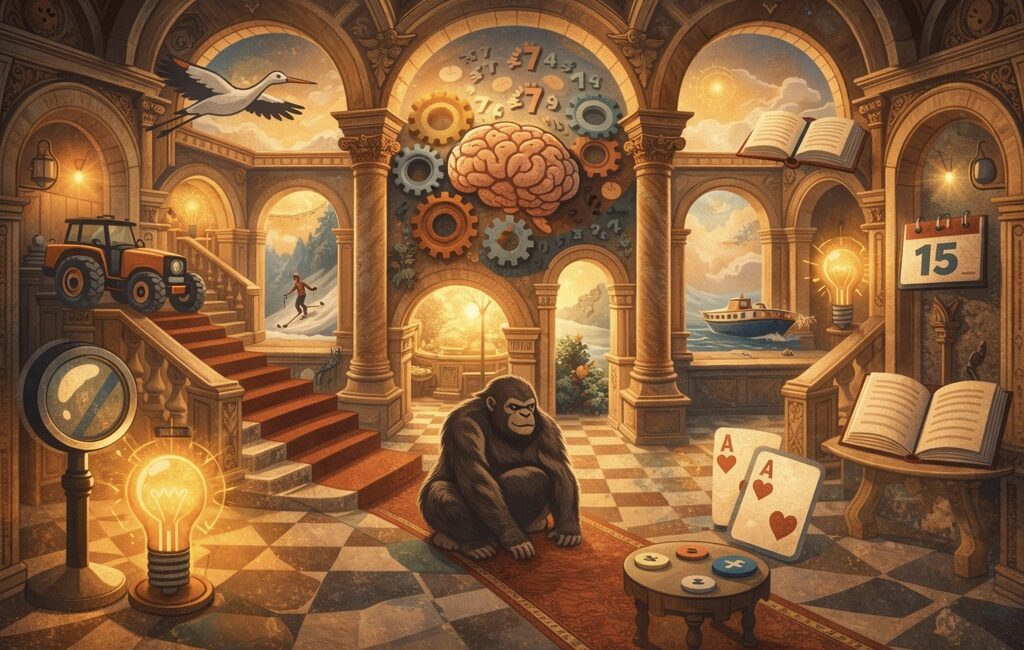
- a small tractor, as he plows, the giant light bulbs jump out of the soil
- a stork flying past that light bulb
- the stork holding a sack closed by a button
- the sack landing on a table like a tablecloth
- the tablecloth becoming a snowy hill with a skier
- a gorilla tripping the skier
- the gorilla jumping into a boat
- the boat growing wheels like a bicycle
- the bicycle smashing into a bottle of a size of a skyscraper
And voilà, now the list has a story.
It may sound silly, but that’s exactly the point.
Once the first image is in place, each one cues the next. Shawn demonstrates this beautifully in the episode by recalling a ten-word list after hearing it only once.
Technique #2: The memory palace
This is one of the classics.
You take a place you know well—your home, your childhood apartment, the route to the store, your office—and mentally place items along that path.
For example:
- your mailbox is overflowing with milk
- eggs are frying on the driveway
- the porch steps are made of bread
- popcorn explodes when you open the front door
Because the place is familiar, your brain gets a reliable structure to walk through later. Instead of trying to remember floating items in space, you revisit a known route and pick them up one by one.
That makes it great for shopping lists, speeches, ordered points, or anything you want to recall in sequence.
The important catch is that one memory palace is best used for one set of things at a time. Reusing the same exact path for different lists too quickly can get messy.
Technique #3: Person-Action-Object
This one is especially fun if you like cards, mnemonics, or anything that feels a little bit like mental engineering.
The idea is to assign every card in a deck a:
- person
- action
- object
Then, instead of memorizing each card individually, you combine three cards into one image:
- first card gives the person
- second card gives the action
- third card gives the object
So instead of storing three separate items, your brain stores one bizarre scene.
For example, in the episode Shawn gives examples like Edward Snowden swinging a door, or Steve Martin lifting a microphone. That single image encodes three cards in order.
It does require prep work up front, but once built, it becomes a very powerful compression system for memory.
The deeper lesson: tricks are just training wheels for attention
One insight I really liked from this discussion is that memory techniques are not just about "hacks."
They force you to actually pay attention.
Take names, for example.
Most of the time when we meet someone and immediately forget their name, it’s not really because our memory failed. It’s because we never truly encoded the name in the first place. We heard it, but we didn’t work with it.
A memory trick helps because it makes us do something with the information. We create an image, a link, a pattern. In other words, we give the brain a reason to keep it.
That’s a useful reminder far beyond memory competitions.
Memory, effort, and mindset
Near the end, the conversation shifts into something I think matters just as much: the relationship between effort and ability.
There’s a powerful idea here:
Memory skill is not the same thing as intelligence.
And more broadly, natural talent is rarely the full story.
We talk about practice, hard work, and the danger of praising people only for being "smart." That ties in nicely with Carol Dweck’s work on mindset: when people believe success comes from effort, they’re more likely to persist through difficulty. When they believe success is supposed to come naturally, challenges can feel like proof that they’re not good enough.
That’s not just relevant for kids. That’s relevant for all of us.
Whether you’re learning memory techniques, coding, writing, public speaking, or anything else really, the principle is the same:
Hard work beats talent when talent doesn’t work hard.
A practical takeaway
If you want to try one thing today, try this:
The next time you need to remember a short list, don’t write it down immediately.
First, turn it into a chain of ridiculous images.
Start with 10 items. Not 3. Not 5. Go a little bigger than feels comfortable.
You may be surprised by how well it works.
And if you want to go further, try building a simple memory palace using your home or daily walking route. Once you get the feel for it, you start noticing that your brain is much more capable than you probably gave it credit for.
Final thoughts
This episode was a fun reminder that a lot of seemingly extraordinary skills are learnable once you understand the mechanism behind them.
Memory techniques are not magic. They just feel like magic when you first see them in action.
And honestly, that’s my favorite kind of topic: something practical, a bit nerdy, surprisingly powerful, and immediately usable.
If you haven’t listened yet, check out the episode here:
Full transcript
Shawn: Hello, and welcome back to another episode of the DevThink podcast with Shawn and
Nikola: Nikola.
Shawn: Yeah. Today, we have one of my favorite topics to think about and talk about, which is memory. Human memory, how to improve it, tricks for memorizing things. And I probably first got involved in learning about memory techniques from being interested in magic and hanging out with magicians and going to lectures and seeing mentalists and things like that. And one of the things that I learned was to memorize a deck of cards, the purpose of which would be to do magic tricks by knowing the order of the complete deck. And so that’s something that I did for fun. However, I memorized one specific order. And if I wanted to do any of those tricks, I needed to take the deck of cards and put them in that particular order, and then I could do any number of of little tricks. And there are people though that can for real in under a minute memorize a legitimately shuffled deck of cards, actually multiple different decks of cards, and then recite back in order the, you know, multiple decks, even if the multiple decks are shuffled together. So it’s not even, you know, there could be more than two two of hearts, you know, within three cards of one another. So remembering faces, remembering names, remembering dates, remembering phone numbers. Just all these things are possible, and they’re actually not difficult to do. They’re just tricks. There’s a book called Moonwalking with Einstein that I have recommended to Nikola recently. And it’s about a guy who’s a reporter, a journalist. He went to a memory championship, and he observed people performing these feats and befriended a couple of them who then trained him. The very next year, this author goes back to the same memory competition and wins first place. So the point is, all it is is tricks. It’s training. And if you can learn the techniques, which are very simple some of them I can describe to you in under a minute and you can immediately go use them. And others require some preparation. You have to pre memorize certain things so that later it’ll be much easier to recall them. So, Nikola, do you have any experience or big thoughts on this?
Nikola: First of all, yeah, that’s like awesome. It’s I think it’s very good to invest time to learn some of these, as you call them, tricks. Because, of course, more things that you can remember, I think it’s better, right, in any case. Right? Is it maybe you’re not remembering the syntax or whatever? Okay. With the syntax, to be fair, you probably just go online. Right? But, you know, other stuff. And, actually so I was interested in it as well, which is not surprising that we’re interested in the same thing. Right? Although, definitely not as thorough as you did. And as we were talking about this, I have a book called by Ramon Campayo that I started reading some time ago. And to be honest, that didn’t go get far. It’s actually, I believe that the title the original title is in Spanish. I’m gonna butcher this because I know zero Spanish. Maybe. I don’t know. Oh, excellent. So all those soap operas that I watched in my mom paid off. Nice. Anyway, so in, like, maybe just first fifty pages of this book, I learned few techniques that I honestly use till this day. And now as I mean, as you mentioned that we’re gonna do this talk, I really have to question myself why I never went through this whole book.
Shawn: You forgot.
Nikola: Because, I mean, I see the value. Yeah. Go figure. Right? Mean, I see and I know the value of this. So I definitely I mean, this year, quote, unquote, New Year’s resolution was to finish all the books that I started but haven’t finished, which I usually don’t do, but, yeah, you know, life happened. And what I’m gonna do actually so I’m gonna ask you, have you so I know you mentioned that you have, but, you know, please go more into detail. So you mentioned that you’re kinda like remembering the sequence of the cards. But can you tell me, could you remember if I give you a sequence of totally random words? Do you have a system for that?
Shawn: Yeah. So there’s a technique called chaining, and you and I have talked about it earlier. You actually read me a list of words, and I think I asked you to give me two or three seconds between each word so that I could try to remember, you know, use this technique. And know, we went through I think it was was it 10 words?
Nikola: Yes. 10 words.
Shawn: And this is just from what was it? A half hour, forty minutes ago that we did this?
Nikola: Yes. And just just so that we do this, how are you gonna do it? Do you want me to read these words and then you’re gonna say how you kinda, like, remember them? Or are you just gonna go and tell me all those I’m gonna
Shawn: try to recite the words now from memory, even though I spent zero time trying to memorize it from when we first did this, you gave them to me. I repeated them right back immediately. And then I have spent no more time thinking about them. Right?
Nikola: Awesome. So Spotlight. Watch it.
Shawn: Yes. So, you know, if I get nine out of 10, we’re good. So the words were tractor, light bulb, stork, button, table, skier, gorilla, boat, bicycle, bottle. Awesome. Was that is that alright? Just
Nikola: a sec. Let me
Shawn: So see. I I’m sure it was. So so here’s the thing. There’s a very simple technique, and you can use this every day. This is something great you can just use even for memorizing memorizing a shopping list. And it’s such a simple technique. I promise you, you could learn this immediately. I was on vacation with my brother and his family last year, and we were sitting in the car waiting for our wives who were in the grocery store. And I told him that, and he didn’t believe me. So I said, okay. Why don’t we do it right now with just, like, five items? And he said, okay. And I told him the technique. I listed some random things. I was just looking out the window and I picked, you know, some stuff I saw. And then I actually gave him more things than I told him I was going to. And he remembered them all perfectly. And then weeks later, we were talking on the phone and I prompted him and he still remembered them all. And it’s great because, basically, people are bad. Humans are bad at remembering words and numbers. We’re amazing at remembering pictures. Actually, I just actually heard of a a study recently where I don’t know if it was a study. It’s more research. They would take some people and put them in a room, and they would flash a bunch of pictures on the screen for, like, less than a second each. Say it’s a hundred pictures. Then they could hand them a book or a slideshow. I don’t know how they did it, but they asked them to identify any pictures they had already seen. These they had less than a second per picture. Right? And they had, I think, something like an 80 or 90% accuracy of remembering whether they had seen it or not. So this technique is called chaining, and it’s ridiculously simple. All you need to do is each word leads into the next word. And the way that you do that is you make a series of pictures in your mind, each one linking to the previous. You if I tell you to remember milk, like for your grocery list, do not imagine a glass of milk. You will not remember a glass of milk if I tell you to do that. What you will remember is if I say milk and you imagine, you know, pouring milk in in someone’s face at work or someone slipping in milk or something. You need something. The more outrageous, the better. As a matter of fact, anything that provokes emotion, especially violent or disgusting or sexual images are much more likely to stick with you. So, you know, anything completely off the wall. So for this list that we did, the first word is tractor. And I remembered that here’s here’s another trick. All you have to remember is the first word. The first word will remind you of the second. The second will remind you of the third and so on. A little trick you can use to remember the first word is if you are talking to someone and you’re demonstrating this little trick, you can use them to remind you of the first one. So the first word is tractor, and I’m looking at Nikola on a video chat right now. And I just pictured a little tractor just mowing his hair. So then I picture I’m seeing the tractor in profile. And as it turns toward me, I see the front of the tractor is a giant light bulb. So the tractor, you know, tractor having a huge light bulb on the front is novel. The next word is stork. And what I picture is the light bulb is now basically the moon and flying in front of it in is this bird flapping holding a sack the way that, you know, in storybooks, they have, like, a baby in a, you know, in a piece of cloth. And then the next word was button. So I picture the stork is holding the cloth, and the top of the cloth is held together with a button, but the button flies off and the sack falls down. The next word is table. So I picture the white cloth sack falling flat and landing on a table and becoming a tablecloth. The next word is skier. So this the tablecloth obviously becomes a snowy hill with a skier going downhill at full speed. The next word is gorilla. So right at the bottom of the hill, I imagine a gorilla jumps out from behind a tree and trips the skier who goes flying. The next word is boat. So a gorilla throws on a sailor hat and jumps into the boat and sails into the water, which is, of course, ridiculous. The next word was bicycle. So I imagine the boat going really fast and running into the shore and running up on land and two wheels appearing at the bottom of it. Now the boat is competing in the Tour de France with the other bicyclists. The last word was bottle. So the gorilla in the boat bicycle smashes into a giant bottle. I can’t really explain why I thought of this more. It’s like a a celeb celebratory bottle of champagne at the end of the race or kind of like the bottle that you break on the bow of a ship during its naming. And all you have to do is that you don’t wanna use if you ever have to think of gorilla, don’t use what I use. You have to use something that you come up with. Just the first thing that pops in your mind that’s ridiculous and silly, come up with it and try it with a shopping list of, I’m not kidding, 20 items. You know? Don’t even you can try it start with 10. Don’t start with five. That would just be silly. Five you know, start with 10 or 20 at least, and you will be amazed at how well this works because that’s the way our brains operate.
Nikola: Yeah. Because so I read somewhere that our brains kinda, like, don’t care about normal stuff because if it would be always on, we would go crazy. So it’s looking for totally weird stuff that are not usual. So if you as you you basically thought of, a tractor running on my head, which kinda, like, makes no sense, that the brain kinda, like, captures that as an important thing because it’s different from usual patterns.
Shawn: Yep. So like, that’s why I said, if you try to remember a glass of milk to remember you need milk at the store, you are not going to remember milk. Although one silly thing, if you only need to buy five or six things, I’ve actually personally found, I haven’t learned this anywhere. It’s something I figured out myself. If I remember that I need six things, I’m much more likely to be able to go, okay. I remember four of them. What were the other two? Okay. And then figure out what the other two are. Whereas if I just say, okay. I need milk, bread, eggs, cream, whatever, then it’s very easy to get home and realize you forgot one of them. But somehow, I don’t know why knowing the number of things I need to remember will help me remember the missing items.
Nikola: Cool. Cool. This actually reminded me of when you said five things. I remember that one thing that I was doing in, you know, high school slash university, when you had to remember a stupid thing of stupid list kind of like, I would take the first letter of each item, and if it well, when it made some acronym that was cool, I remember that without a problem.
Shawn: Yeah. You know, mnemonics. Were you
Nikola: doing something like that?
Shawn: Well, yeah, we were taught that. Like, for example, to memorize the order of the planets and other things like that. What was the, I don’t know. Think there was there were a couple times we learned something about the way that, the order of operations in some algebra problem were done. But yeah. Because if you couldn’t remember that or or RoyGBIV. Right? Did you have RoyGBIV? Well No? You didn’t learn the the rainbow in English, but Roy G. Biv. Red, orange, yellow, green, blue, indigo, violet. Those are the colors of the rainbow. Interesting. And it had that happens to spell Roy G. Biv, which doesn’t make sense, but at least it’s pronounceable. Whereas Yeah. Yeah. When I was in the grades of school where we learned about the planets, for example, they still considered Pluto to be a planet. So one of the techniques people use was my very my very excellent mother just served us nine pizzas, which is a nonsense sentence, but you can remember it. And the beginning of each letter is the beginning or the beginning letter of each word is the beginning letter of one of the, you know, nine planets at the time. So Awesome. Yeah. Those are common things. And another one that I learned from the book Moonwalking with Einstein, which I I found to be really interesting, especially with my background in card magic, is something called the person action object method. And it’s a really cool method because what it lets you do is instead of memorizing cards the hard way like I did, where I know exactly one deck in one order, and that took me, I don’t know, weeks to learn. And I also have to practice it every once in a while, or I mostly forget. I can pick it up really quickly when I go back to it, but I may need a little refreshing. But this lets you memorize an entire deck of cards way easier in way less time in a matter of minutes, and in some people’s cases, well under a minute. Some people can memorize cards, a whole deck of cards in under a minute and memorize many decks of cards, sometimes a dozen or more decks that they can then repeat back. And oh, before I get to that, I have to do I do have to mention the memory palace, which is one of the oldest memory tricks. And by oldest, I mean, you know, BC, like, many thousands of years ago. A memory palace is it’s a very simple concept. Imagine a place you know well. It could be your house, your school, the house you grew up in, your parents’ house. If you walk to the corner store and on the way there, you know, every driveway, every neighbor’s mailbox, every lawn, whatever, what just a series of steps in a journey, or a series of locations in a house. So for example, in your house, it may be you may imagine your mailbox, then you may imagine your driveway, then the steps to your porch, then your porch, then your front door, then the floor just inside your front door. And then, you know, going on so on and so forth. Like maybe if your stairs have a landing, you imagine the first set of stairs, the landing of the second set of stairs, and then the top floor, just divide a location that you know, and you could visually in your mind, walk through and recognize many details. All you need is anything like that. Then say you want to memorize something like a grocery list. You would start off with a mailbox. Let’s say you wanted to remember to get milk. Imagine you open your mailbox and just milk starts pouring out all over the place like a waterfall.
Nikola: You’re not gonna forget that. I’m gonna just Yes. Awesome. I’m just gonna stop you here. It would again be wrong to imagine a, like, a proper box of milk or whatever in there because that would be normal. Correct?
Shawn: Yeah. I mean, not that people get deliveries of milk in their mailbox. Yeah. But you don’t wanna imagine a carton of milk. You need it pouring out. You need Yep. Something crazy. Like, maybe in front of your house, if you have a storm sewer, like, just milk flowing down the road like rain. Then on your drive say you need eggs. Maybe the driveway, you’ve got eggs frying on the driveway, way, and maybe there are squirrels or some creatures trying to eat them. And then for bread, maybe the the stairs to your porch are made of bread. And as you’re trying to walk up them, you know, birds are eating them or it’s being toasted or something crazy like that. And if you wanted to get popcorn, imagine that when you opened a lot of places that I’m familiar with have two doors. You have the what we call the screen door, which has got screen or glass in it, it’s very thin. And then you’ve got the real wooden door with the, you know, with the deadbolts and all that. Maybe when you open the screen door, just kernels of popcorn come flying off and hitting you in the face. Right? And you go on like that, and you can memorize easily, you know, dozens or hundreds of things that way. So just going back to what we just said, you know, we did milk, eggs, bread, popcorn, and you’ll remember that for days. So this, person action object takes advantage of that. And, earlier, if you remember, I said a lot of these things are things you can do immediately. That memory palace, you can go use that right now. The chaining, you can go use that right now. Incidentally, there are two separate ways of remembering something, both of which give you the ability to remember things, not only remember them, but also in a specific order, which might be handy as well. So the person, action, object requires you to, in advance so here’s the hard part. Here’s what you have to actually prepare. A person, an action, and an object for every single card in the deck. So I have six cards in my hand. I have, I’ve been working on this myself. I’ve only gotten halfway through the deck, so I have a person action object for 26 out of the 52 cards. So here I have the queen of diamonds, which to me represents Bruce Lee swinging nunchucks. I have the jack of spades, which is Jack Black singing into a microphone. Then I have the ace of clubs, which is Arnold Schwarzenegger lifting a barbell. I have the five of spades, which is Jack Nicholson chopping a door, like breaking through a door with an axe. I have the king of diamonds, which is Steve Martin riding a horse. And I have the seven of hearts, which is Edward Snowden flushing a cell phone down the toilet. And notice that the actions have to take place on the object. Like, I couldn’t imagine Nicolas running. I mean, maybe if I imagine him running on something, but it really helps to have the action and the and the object you know, the the object being acted upon. So now that I’ve named these, the nice thing about person action object is it allows you to memorize three cards with one picture. So I’m gonna go through, and the cards are in a semi order. They’re only six, so it’s not a big trick. This is just for demonstration purposes only. If I lay out three cards here, I’ve got seven of hearts, queen of diamonds, five of spades. So if I wanted to remember that, I would remember Edward Snowden swinging a door. Right? I’m taking Edward Snowden from my seven of hearts, which is Edward Snowden flushing a cell phone down the toilet. I remember swinging from my queen of diamonds, which is Bruce Lee swinging nunchucks. And I take the object door from my five of spades, which is Jack Nicholson chopping a door. Right? So I have Edward Snowden swinging a door. So I need to put him somewhere. I’ll put him, you know, somewhere in my memory palace. And I picture him. He’s got, like, a door on a chain, and he’s swinging it. And, you know, NSA agents are coming to try to arrest him. They’re holding handcuffs, he’s swinging a door around him to keep them away. K? That’s ridiculous. I can remember that. Next one, I got king of diamonds, ace of clubs, jack of spades. So king of diamonds is Steve Martin riding a horse. I won’t go through them all again. So these three cards in order would be Steve Martin lifting a microphone. Okay. So Steve Martin is a well known comedian, and I can picture him lying on stage with a giant microphone that’s, like, crushing him, he’s trying to lift it. And, you know, he’s got balloon animals around him, and the audience is laughing or something. Alright. So going with what I just said, I’ve got Edward Snowden singing a door swinging a door. So that would obviously be the seven of hearts, queen of diamonds, five of spades. So that’s seven of hearts, queen of diamonds, five of spades. Yes. That is correct. And then the next one, I had Steve Martin lifting a microphone. So that would be king of diamonds, king of clubs, jack of spades. So king of diamonds, ace of clubs. Oh, ace of clubs. I actually made a mistake. I said king of clubs, didn’t I? The ace of clubs. So I did make one mistake there, but I’m still practicing this. But you can still see I got five out of six with two images, and that’s all I needed. I I was trying this out last night, and I actually did the full 26 cards, and I got 23 out of 26 correct. So not bad for just starting. And, you know, you can easily see there are 52 cards in a deck, but it would only take you 18 places in your memory palace to memorize an entire deck of cards.
Nikola: Awesome. Awesome. A thought that I had when you said the grocery list, right, and that you said you’re gonna use your home as a memory palace, then I figured out, so let’s say that a lot of times when you go shopping for, you know, groceries, a lot of times you buy, let’s say, the same things. Right? And, for example, you have someone coming over, then you have similar but yet different kind of set of things. And then a thought came, and would it be useful to, you know, store in your memory palace in a box where in on top of that box, says, I don’t know, the name of your movie, for example. And immediately, you would know that in this drawer, you have a stack of things well, a movie, so to speak, for when you have normal grocery shopping. Would this be, you know, useful or not?
Shawn: I don’t know. I think it’s if it’s not something that you can mentally walk through, then it might be difficult. So one thing about a memory palace is that you can’t if you have a great memory palace, say it’s your house and say you know the location of shelves and drawers and, you know, countertops and you have a couch with three cushions which you can each use for something an individual item. Say you can store hundreds of things in your house. That doesn’t mean that you only have that one memory palace because you can’t reuse the same memory palace to remember a bunch of different things simultaneously. It’ll become confusing. So you actually need separate memory palaces for separate things. Or if you can come up with 50 things in just your bedroom, you can use just your bedroom to remember one set of things and maybe just your kitchen to remember another. So you will need to come up with additional memory palaces. So another interesting thing, if you memorize something using any kind of trick and you go over it enough times, you’ll actually remember it and forget the trick. Here’s so there’s a book called the memory book. Was written a long time ago, probably like in the sixties or seventies by the name Harry Loraine. And one thing I learned from there is that every single memory technique that you use is only a way to trick your brain into actually thinking about the thing you’re trying to remember. Because I’ll give you the perfect example that every single person can identify with. You meet someone, they say, hi, my name is blah, blah, blah. And two seconds later, you don’t know their name. Now you would say, many people would say, I forgot their name or I can’t remember their name. That’s incorrect. You never knew their name because you never bothered to remember it. You never bothered to put any thought into it. But if you meet someone and they say their name is Dawn and you imagine you look at their face and you see, like, maybe their hair is, you know, a certain color and you imagine the sun coming up behind it. You’re gonna remember their name is Dawn. But here’s the thing. Once you’ve remember use that trick once or twice, you’re gonna remember their name is Dawn. You’re not even gonna picture the image anymore. It’s just the fact that you’re investing any mental power into remembering something that actually makes you remember it. All these tricks are just ways of tricking you into thinking, really.
Nikola: Awesome. So basically, we kind of like a long way of saying we’re not using our potential in terms of we’re not doing nowhere near how what we could be doing.
Shawn: Yeah. And and by I don’t mean any of that crazy, you know, we use 10% of our brain stuff because that’s all, you know, bull. But it’s very important to note, and I learned this from Moonwalking with Einstein, is no correlation between intelligence and memory ability. If you train your memory, you will be amazing at it. If you are below average IQ or above average IQ, it does not matter because these are just techniques. It’s like, you know, depending on no matter what your IQ is, if you lift weights, will become stronger. If you use memory techniques and you actually train your brain and trust your brain, you’ll get better memorizing things. And that’s just a fact.
Nikola: This is awesome. And this goes along with kinda like something that I live by, and that’s always, always, always try to out outwork. I mean, everybody, but the one that you should be outworking is yourself from yesterday. And that’s good. Everywhere where you can, let’s say, excel by doing more work, that’s good. You don’t need you know, you don’t like, you said the IQ. Screw that. I mean, honestly, so what? He has, you know, one sixty IQ. But if you’re willing to put in twenty hours a week more than that person, sooner or later, you will surpass him. But this you know?
Shawn: Yeah. There’s a author many people are familiar with named Malcolm Gladwell who writes a bunch of really interesting books on sociology type stuff. And one of them is called Outliers. And there’s this concept in our culture and probably in many cultures that there are some people, you know, like I mentioned Arnold Schwarzenegger before, people often will refer to Warren Buffett or Bill Gates, or certain people who have become very successful as, oh, there’s something about them. Let me let me study their life. Like, look, Warren Buffett had a paper route when he was young. He was industrious, blah blah blah. And they think that there’s something about some people that they’re just destined for greatness. Because without anyone teaching them, without any pressure or, you know, secret tricks, they were internally driven to become the hero that we see them to be. And this book lays out very clearly that that is simply not true. And one of the examples given was that if you take students of the violin who are all new and you evaluate them, a professional violin teacher evaluates their abilities, they can be ranked into those who have more natural talent and those who have less natural talent. But if you fast forward a couple years and you look at the ones that have put in less work into their practice and those who have put more work into their practice, it is it is absolutely impossible for the ones with talent to be anywhere near as good as the ones who practice more unless those with the talent also practiced. So the the initial talent, the initial discouragement of, oh, I tried this new thing and it was hard and the guy next to me, you know, was better at it than I am. I guess it’s not for me. That’s that’s just all self defeating, and it’s really harmful. What’s true is that if you practice, you’ll become good.
Nikola: Awesome. Like, one of my favorite quotes that I have on my, like, the blog is hard work beats talent when talent doesn’t work hard. Because let’s face it, if you have two people that are the same and they work the same, but the other one was, let’s say, talented a bit more, let’s face it. He’s always gonna be number one. But, hey, if you work, you’re always gonna be at least number two, and that’s way more than most people want to do. So work hard people.
Shawn: Yeah, and actually this reminds me of the last thing I wanna throw in. I don’t wanna go too long on this, belabor this, because it’s not about memory specifically, but I was watching a a BBC documentary, several years ago, and the psychologist was saying one of the worst things you can possibly say to a child is you’re so clever. So imagine your child comes home and they’ve won the spelling bee or they got good grades or whatever they were. They made the honor roll. If you say, wow, you’re really smart. Are damaging that child. What you need to tell them is, wow, you must have worked really hard because and this has been proven in research. This isn’t just, you know, feel good stuff. If you tell a kid, wow, you’re really smart. Then they come upon a problem that they have trouble with. They are they’re supposed to be smart. This is supposed to be easy for them. So when it’s not easy, they get discouraged and they quit. But if you tell someone, oh, you must have worked really hard. Then when they come in on a challenge, they just work harder. And so you have some people that were conditioned to think, I’m smart, things come naturally and easy to me, and the things that don’t come naturally and easy to me, either I am not as smart as people think I am, and I should be ashamed and embarrassed and hide it from everybody and let my grades slip and be a disappointment to my parents who are gonna not love me anymore or, you know, judge me more cruel. All this is in their head, of course. That’s not real. Or you have people who realize that there’s a correlation between work and accomplishment. So just keep that in mind for yourself. And, you know, if you have any, children, if you’re in a position to teach or mentor anybody, try to keep that in mind because people are way too hard on themselves. People seem to think that they should be better faster because they’re comparing what they know to what they think other people know. And they way blow out of proportion what how much smarter than them others are. And they undervalue their own value.
Nikola: Yeah. Awesome. Actually, the name of the researcher that made this, let’s say, thinking popular, if I’m not mistaken, is Carol Dweck. Her book is, called Mindset. She also has a TED talk on this topic. I mean, honestly, you summarized it perfectly. And, yeah, this is something that I’m, you know, really working with with my kids to let them know that they made this thing good just because they tried hard or long to do it.
Shawn: Yep. And I I my son, I also try to make sure I choose my words carefully in such a way to encourage him in the same way because, you know, he is really smart and things do come naturally to him, which is a huge disadvantage in some ways because if he falls into the mindset that things come easy to him, then when he has a real challenge, he’s gonna, you know, have a major emotional problem to deal with and, you know, just don’t want that. Yep. So great. Carol Dweck, Mindset is the book. I just looked it up when you mentioned it. And you know what? I have heard of her. Actually, someone else recommended her to me in the book Mindset, a month or two ago. So I should maybe go back and take a look at that.
Nikola: Yeah. I still haven’t read it. I have it, an actual copy. I have a lot as you know, I have a lot of Audible books, but this one, I got, the hard copy as well. And, of course, I mean, if people want the gist of it, they just got it. Or if they want more from the author, they can see her TED Talk.
Shawn: Yeah. And, you know, a last little mnemonic thing. If you’re trying to remember the name of the person, but mindset, her name is Carol Dweck. So maybe you start with Carol, and you imagine, like, a bunch of kids singing a Christmas carol. And you know, Dweck, I don’t really have a good trick for that but
Nikola: Deck, deck of cards, Dweck deck.
Shawn: Yeah, it could be close. Or mindset, maybe you picture like someone has a set of something like on a shelf there are three or four of them in there, you have minds, like maybe some brains in jars, like mindset. If you can remember enough to Google Carol mindset or even Carol mind, you’ll probably find it. So do these little things and associate things with pictures, and you will remember more easily anyway. Awesome. Alright. So thanks, Nicolas. Good show. Any last remarks?
Nikola: Thank you, Shawn. It was a great talk. One thing that just popped in my mind is, okay. All this memory improvement, awesome. Right? Have you tried improving your reading speed? If you have, we’re gonna definitely do another show because we don’t wanna drag this one, but I’m just curious.
Shawn: No. I’ve read about it, I’ve heard mixed things about whether or not it’s actually a real thing and beneficial, so I think that might be a topic for another discussion.
Nikola: Awesome. Let’s do it. Till then, see you guys.
Shawn: Bye bye. Bye bye. Thank you for listening to the DevThink podcast. To reach us for feedback, show suggestions, or any other comments, email us at [email protected].