

Nikola Brežnjak blog - Tackling software development with a dose of humor
  • Home
  • About me
Home
About me
  • Nikola Brežnjak blog
  • Home
  • About me
Quick tips

Productivity tip: rate things 1-10 without 7

TL;DR

I started using a simple rule: rate 1–10 without 7.

Because 7 (for me) usually means one of these:

  • meh
  • I’m being polite
  • I don’t want to think too hard about it
  • I don’t want to make a decision right now
  • I’m thinking of staying home instead of seeing a doc. Will check in with myself tomorrow…
  • …

So, now I force myself to choose:

  • 6 => not so great actually (wouldn’t recommend / wouldn’t go to the doc)
  • 8+ => I genuinely liked it (would recommend / would go see a doc today)

This actually helps me make a decision instead of shrugging it off with a 7 🤷‍♂️

Anyone else using a rating/feedback "trick" like this?

!TL;DR

If someone asks you to rate something on a scale from 1 to 10, you pretty much know right off the bat if it’s something like a 1 or a 2, and if it’s 9 or even a 10.

But, what do you usually do when you’re like:

Well, not bad.
Not great.
Not sure.
Not ready to hurt their feelings…
Let’s just go with … 7

Newer generations might just say:

you know, 67 🤷‍♂️

But, I digress.

The fact is, this shows up everywhere:

  • "How was the restaurant?" — 7
  • "How was the talk?" — 7
  • "How’s the new feature?" — 7
  • "How would you rate this candidate we just interviewed?" – 7
  • "How do you feel about your own work this week?" …also, 7

If you’ve ever answered with a 7, you’re not alone. Whenever I don’t want to make a decision, I’d say 7. But here’s the thing – most of the time, 7 doesn’t mean "good".

It means: "I don’t want to think too hard about this right now."

So here’s a simple trick that makes your ratings way more useful: rate on a 1–10 scale… but pretend there’s no 7.

That’s it. Remove 7 as an option. Uninstall it from your OS (I know, references are cringe 😬).

Because 7 is the default. It’s what we say when we’re uncertain, polite, rushed, or trying not to offend.

If there’s no 7, you’re forced to choose:

  • 6 → "Not so great actually"
  • 8+ → "Oh yeah, I genuinely liked this"

And that single "restriction" helps you in actually making a decision faster.

Why this works (and why 7 is sneaky)

A 1–10 scale looks precise, but we don’t treat it that way.

In practice, most people use it like this:

  • 1–4: bad
  • 5–6: meh
  • 7: safe meh, but with a smile 🙂
  • 8–10: good / great

So 7 becomes a dumping ground for anything we can’t be bothered to classify.

Removing it forces you to answer one key question:

Would I recommend this… or would I warn someone?

If you lean "recommend", you’re probably at 8+.
If you hesitate, it’s probably a 6.

Conclusion / Recap

  • 7 is usually a placeholder for uncertainty
  • Pretend there’s no 7 on a 1–10 scale
    • Choose 6 if it’s not actually great
    • Choose 8+ if you truly liked it

And voilà: your ratings stop being polite noise… and start being honest (and sometimes brutal) signal.

Next time someone asks "How was it?" and your brain reaches for 7, just smile and say:

"Well, from 1-10 and if 7 isn’t allowed, then…"

Hope this tip serves you well ✌️
Quick tips

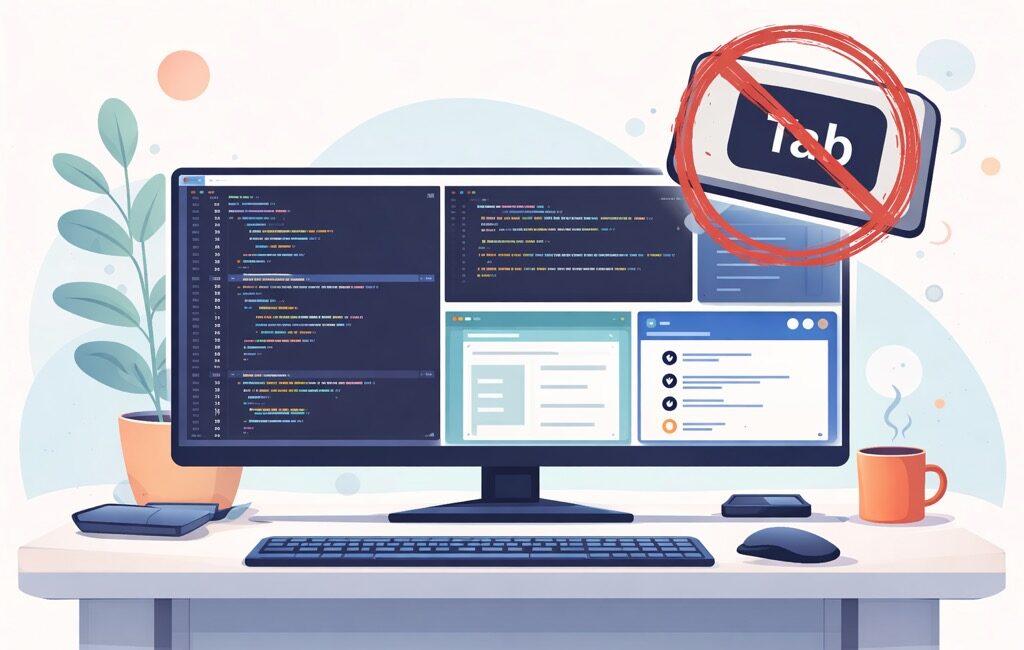
Stop Tabbing. Start Using Your Monitor

OK, I admit, this one is going to be weird. So, buckle up…

Tabbing feels like it costs a second. It doesn’t. It costs your train of thought.

You know the move: you’re testing the app and it’s crashing, you’re mid-sentence of screaming at prompting your favorite LLM to fix it, and then you Alt+Tab (CMD + Tab for fellow Mac users) to Slack "just for a sec", then you come back and… reread the last 15 lines like it’s a novel you forgot the plot of.

Hot take: tabbing is a context tax. And it adds up fast.

TL;DR

  • The real cost of tabbing isn’t the switch — it’s the mental reload after.
  • The easiest fix isn’t discipline, it’s layout: make your screen a multi-window workspace.
  • Use a big monitor + split your apps into a "cockpit" so you don’t need to switch contexts.
  • On macOS, use Spectacle (not affiliated) or some other window tiling app

The real problem: you’re not switching apps, you’re switching brains

If you had to physically stand up and walk to another desk every time you checked Slack, you’d do it less.

Alt+Tab is the "teleport" version of that walk — and that’s exactly why it’s dangerous. It’s frictionless distraction.

Because when you tab away, you don’t just lose what’s on the screen, you lose:

  • the next step you were about to do,
  • the mental model of the code,
  • and whatever fragile "flow" you managed to summon that day

The cheat code: stop tabbing by making your monitor do the work

This is the part nobody tells you:

The best productivity "hack" is having everything visible at once.

Not 27 windows stacked like lasagna. I mean a deliberate layout where your brain doesn’t have to switch, it only has to look.

A bigger monitor helps because you can run a real multi-window layout, for example:

  • Left (60–70%): editor (VS Code / IntelliJ)
  • Right top: terminal (tests, logs, git)
  • Right bottom: browser (docs / ticket) / ChatGPT

⚠️ Note to you, dear reader, if you’re using some layout like that: share it in the comments, I’m curious to hear what’s been working for you.

Oh, and BTW, if Slack is visible, you don’t "check Slack". You just notice if something is urgent. And 95% of the time… it isn’t. Also, don’t get me started on email…

Spectacle on macOS: the "I refuse to drag windows" tool

The reason people tab is often stupid-simple:

"My windows are annoying to manage."

or

"My screen is just too small."

I can’t help you with the 2nd one (tell your boss you need a bigger/external monitor 🤷‍♂️ – tell them, politely, that some dude on the Internetz sent you), but as far as the 1st one goes, you end up stacking everything and flipping through it like TV channels.

That’s where Spectacle comes in.

It’s a lightweight macOS app that lets you snap windows into positions using keyboard shortcuts:

  • left half
  • right half
  • quarters
  • maximize

So instead of:

  • "drag… resize… oops wrong size… now I’ll just tab…"

You press a keyboard shortcut, and the window goes exactly where you want.

The next you know it, voilà — your screen becomes a workspace, not a pile of rectangles.

Goal: reduce tabbing by making switching unnecessary.

A simple "no-tab" layout you can try today

Here’s a clean starter layout (works great on a 27" or ultrawide):

  1. Editor: left side (primary focus)
  2. Terminal: right side (top)
  3. Browser/docs/ChatGPT: right side (bottom)

That’s it.

You’ll be shocked how often you tab just to peek at something that could’ve been visible all along.

One tiny habit that helps even with a perfect layout

Sometimes you still need to switch (different project, different doc, whatever). Before you do:

Write one line somewhere (notes, TODO comment, sticky note):

"Next: update handler → rerun tests → fix validation error"

That single sentence is a bookmark for your brain.

Wrap-up

Tabbing isn’t evil. It’s just expensive.

If you want the cheapest win:

  • get a bigger monitor (or use what you already have smarter),
  • build a consistent multi-window layout like Spectacle on a Mac,
  • and turn "tabbing" into something you do intentionally, not reflexively.

Because the fastest way to stay in flow isn’t to "focus harder".

It’s making it harder to accidentally leave.

Quick tips

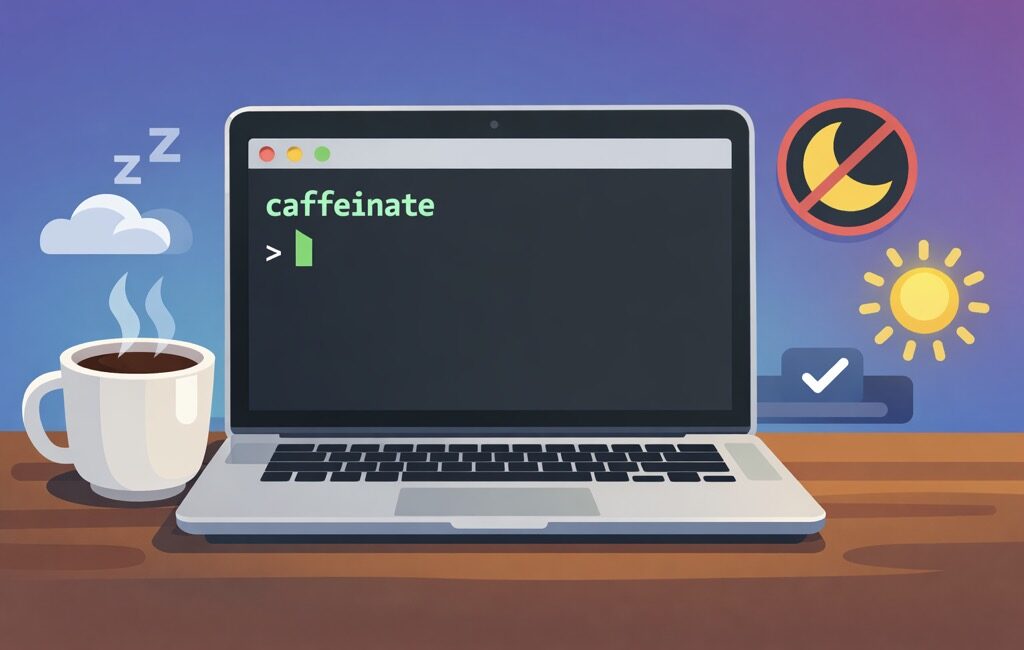
Caffeinate your Mac to prevent it from sleeping

TL;DR

I’ll show you how to use macOS’s built-in caffeinate command to keep your Mac awake:

  • until you stop it
  • for a set amount of time, or
  • only while a long-running command is executing

No additional apps that you need to install, no menu bar junk, no "why is my Mac sleeping again?!" drama.

Why you’d care about caffeinate

If you’ve ever kicked off a long download, rsync backup, Docker build, video export, or "I’ll just run this migration quickly" job… and then came back to find your Mac politely sleeping like an innocent kitten — you already know why this matters.

macOS has an official tool for this, and it’s been sitting right under your nose:

caffeinate

It’s basically the Terminal equivalent of "No, macOS, we are not done here."

Option #0: The simplest possible usage

Open Terminal and run:

caffeinate

That’s it. Your Mac won’t go idle-sleep as long as this process is running.

To stop it press Ctrl + C

Option #1: Keep the Mac awake for a fixed amount of time

Sometimes you just want to keep your Mac awake for 2 hours (and keep that Slack icon 🟢 hey, I don’t judge), and then you’d pass in the -t parameter (which indicates seconds):

caffeinate -t 7200

That’s 2 hours (60 60 2 = 7200). Yes, we still count seconds like it’s 1999.

A few common ones:

  • 30 minutes: 1800
  • 1 hour: 3600
  • 2 hours: 7200
  • 4 hours: 14400

Option #2: Keep the display awake as well

If for some reason you want to prevent your display from dimming, use the -d switch:

caffeinate -d

Option #3: The best trick — keep Mac awake only while a command runs

This is the chef’s kiss use case; instead of running caffeinate separately, wrap your long-running command with it:

caffeinate -i your_command_here

Example: big rsync backup:

caffeinate -i rsync -av ~/Pictures/ /Volumes/Backup/Pictures/

Example: long npm build:

caffeinate -i npm run build

Example: running tests that take forever because you’re "testing thoroughly" (and definitely not because of that one integration suite):

caffeinate -i ./run-tests.sh

When your command finishes, caffeinate stops automatically. No cleanup required. No "wait, did I leave it running overnight?" paranoia.

Option #4: Run caffeinate in the background

If you want to keep your Terminal usable:

caffeinate -d -i &

That & sends it to the background.

Want to see it?

ps aux | grep caffeinate

Want to stop it?

Option A: bring it back to foreground and stop:

fg

then hit Ctrl + C

Option B: kill it by PID (you’ll see PID in the ps output):

kill <PID>

Handy flag cheat sheet

Here’s the "print this on a sticky note" version:

  • Keep system awake until stopped:

    caffeinate
  • Keep awake for 1 hour:

    caffeinate -t 3600
  • Keep display awake:

    caffeinate -d
  • Keep awake while a command runs:

    caffeinate -i 
  • Display + system, background:

    caffeinate -d -i &

Bonus: a tiny alias (because typing is hard)

If you find yourself using it often, add this to your ~/.zshrc (or ~/.bashrc):

alias awake='caffeinate -d -i'

Reload:

source ~/.zshrc

Now you can do:

awake rsync -av ~/Stuff/ /Volumes/Backup/Stuff/

And voilà — your Mac stays awake, your command runs, and you look like you totally planned it this way.

Hope this was useful, and see you next time 💪

Quick tips

When espanso Breaks on Long Replacement Strings (and How to Fix It)

When espanso Breaks on Long Replacement Strings (and How to Fix It)

Hey friends 👋

Today’s post is a quick one, but it might save you from a few head scratches and keyboard punches if you’re an espanso user who’s been wondering why your juicy long replacement snippets randomly just… don’t show up.

If you’re wondering what Espanso is, check this blog post: Espanso: Because Who Actually Likes Typing Out Their Emails?

TL;DR ☕

  • Long replacement strings (>100 chars) can silently break in espanso
  • This is due to the default clipboard_threshold config
  • You can fix it by setting a higher threshold in default.yml

!TL;DR ☕

If you came for the story, here we go: so, here’s what I ran into…

The Problem: Long Replacements Just Break 🧨

I’ve been using espanso for a while now (it’s a neat little open-source text expander that makes typing repetitive stuff a breeze). All was fine and dandy—until I tried adding a longer replacement string, something like:

- trigger: ":some-long-snippet"
  replace: "Dear passangers, we have good news and bad news. Good news is we are landing. Bad news is we are crash landing!"

And poof—nothing. The replacement just didn’t happen. What’s even worse, it would usually trigger the command prompt in editors (similar to pressing CMD + k or CMD + p).

At first, I thought it was something I’d messed up in the syntax. I double-checked, triple-checked… nope, looked fine.

Then I started wondering if maybe the issue was platform-specific. I’m running the newest version on a up2date Mac. Thought it was some weird key combo or something – but, no.

So yeah, turns out…

There’s a Hardcoded Limit (But You Can Fix It!) 🛠️

After digging around a bit—and with a helpful tip from a fellow redditor—I discovered that espanso has a clipboard_threshold setting buried in the default.yml config file (located at ~/.config/espanso/default.yml).

And it looks like this:

# clipboard_threshold: 100

Yep, it was commented out by default.

So what’s this do? If your replacement string is longer than the threshold (default is 100 characters), espanso silently fails to insert it. No warning. No logs. Nada.


The Fix: Increase the Clipboard Threshold 🙌

To fix this, all you need to do is:

  1. Open your ~/.config/espanso/default.yml
  2. Uncomment or add the clipboard_threshold setting
  3. Set it to something higher, like 500:
clipboard_threshold: 500
  1. Save the file and reload espanso (if it doesn’t reload automatically)
espanso restart

And voilà, your long replacements now work like a charm 🎉

Conclusion

If you’ve hit this issue too, I hope this saves you some time. And if you’re just diving into espanso, maybe take this as a reminder to skim the config docs sooner rather than later 😅

Happy expanding!

Quick tips

Espanso: Because Who Actually Likes Typing Out Their Emails?

TL;DR

Espanso is a text expander tool that will save you lots of repetitive typing. For real.

Ever had to repeatedly type your email address into a form? Check.
How about your name? Surname? Email signature? Check. Check. Check.

Well, instead of risking a typo — like sending that standout job application with the wrong email, and they never get back to you (even though you were certain you were the top pick among the multitude of MAANG folks recently let go—oops, went on a tangent there for a sec 🙂) — how about simply typing ;em and watching it magically expand into your email?

Why Espanso?

I’m in no way affiliated with them, but kudos must be given where due.

Sure enough, there are tools like TextExpander, but Espanso stands out because it’s open source.

Installation

Espanso is cross-platform, with binaries for Windows, Mac, and Linux. I’m sure anyone can find their way around their Installation page: https://espanso.org/install/. If you’re on a Mac and using brew, you can also install it from the command line: brew install espanso.

Accessibility

To use Espanso on a Mac, you’ll need to grant Accessibility access via System Preferences → Security & Privacy → Privacy → Accessibility.

Configuration

On a Mac, the Espanso config folder usually lives at ~/Library/Application\ Support/espanso. The config folder is for Espanso settings, while the match folder (which contains the base.yml file) is where your triggers and replacements should go.

Example

Just as an example, this is how mine looks like (feel free to take the logic behind emojis):

# espanso match file

# For a complete introduction, visit the official docs at: https://espanso.org/docs/

# You can use this file to define the base matches (aka snippets)
# that will be available in every application when using espanso.

# Matches are substitution rules: when you type the "trigger" string
# it gets replaced by the "replace" string.
matches:
# signatures
  - trigger: ";n"
    replace: "Nikola"

  - trigger: ";b"
    replace: "Brežnjak"

  - trigger: ";li"
    replace: "https://www.linkedin.com/in/nikola-bre%C5%BEnjak-892b9a24/"

  - trigger: ";sn"
    replace: "Kind regards,\nNikola Brežnjak\nhttp://www.nikola-breznjak.com/blog"

  - trigger: ";web"
    replace: "http://www.nikola-breznjak.com/"

  - trigger: ";em"
    replace: "[email protected]"

## git
  - trigger: ";ga"
    replace: "git add ."

  - trigger: ";gb"
    replace: "git branch"

  - trigger: ";gc"
    replace: "git commit -m "

  - trigger: ";gd"
    replace: "git diff --color "

  - trigger: ";gf"
    replace: "git fetch --all"

  - trigger: ";gi"
    replace: "find . -name '.DS_Store' -type f -delete"

  - trigger: ";gl"
    replace: "git log"

  - trigger: ";gp"
    replace: "git push origin main"

  - trigger: ";gs"
    replace: "git status"

  - trigger: ";gt"
    replace: "git remote -v"

  - trigger: ";gu"
    replace: "git pull origin main"

## blog
  - trigger: ";bimp"
    replace: "https://nikola-breznjak.com/blog/books/want-improve-read-books/"

  - trigger: ";brem"
    replace: "https://nikola-breznjak.com/blog/miscellaneou/make-remote-developer/"

## emojis
  - trigger: ";eew"
    replace: "⚠️"

  - trigger: ";eet"
    replace: "🤔"

  - trigger: ";eeb"
    replace: "💰"

  - trigger: ";eem"
    replace: "💪"

  - trigger: ";eetm"
    replace: "™"

  - trigger: ";eeh"
    replace: "❤️"

  - trigger: ";eeu"
    replace: "👍"

  - trigger: ";eep"
    replace: "🙏"

  - trigger: ";eef"
    replace: "🤦"

  - trigger: ";ees"
    replace: "🙂"

  - trigger: ";eeg"
    replace: "😎"

  - trigger: ";eev"
    replace: "👋"

  - trigger: ";eel"
    replace: "😂"

  - trigger: ";eec"
    replace: "👏"

  - trigger: ";eeo"
    replace: "✅"

  - trigger: ";eer"
    replace: "🚀"

  - trigger: ";eex"
    replace: "⏭️"

## replies
  - trigger: ";ryw"
    replace: "You’re welcome 👍"

  - trigger: ";rlmk"
    replace: "Please let me know 👍"

  - trigger: ";rbtw"
    replace: "Btw, how are things on your end?"

  - trigger: ";rt"
    replace: "Thank you! 👍"

## misc
  - trigger: ";fd"
    replace: "firebase deploy"

  - trigger: ";wed"
    replace: "Happy Wednesday (a dy on which, historically, most people wed on - thus: Wed nes day). Not really, but it would be a fun fact actually 🙂"

  - trigger: ";cl"
    replace: "console.log("

  - trigger: ";se"
    replace: "select * from "

  - trigger: ";o"
    replace: "open ."

  - trigger: ";im"
    replace: "![]({{clipb}})"
    vars:
      - name: "clipb"
        type: "clipboard"

  - trigger: ";ch"
    replace: "chrome://history"

  - trigger: ";;c"
    replace: "code ."

Beyond the Basics: Advanced Configurations

As you can see above, you can create simple trigger/replace combinations, but also in example of the ;im trigger to insert an image directly from the clipboard in Markdown format.

They even support plugins, and there’s one for all the emojis you’d ever want, and the installation is straightforward.

Conclusion

Espanso is more than a tool; it’s a testament to the open-source community’s ability to create solutions that are both powerful and accessible. I wholeheartedly recommend you give it a try.

If you’re also using Espanso, and have some great tips to share, please leave them in the comments.

Thanks for reading, and hope it was useful 👋

Quick tips

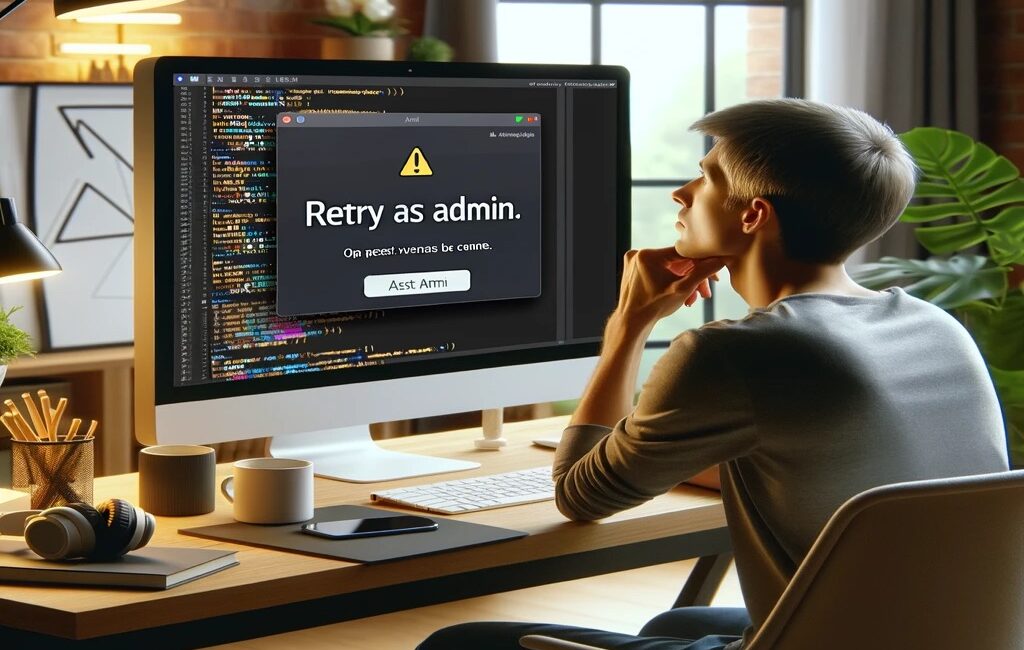
Solving the ‘Retry as Admin’ while saving files in Visual Studio Code on a Mac

TL;DR

If you ever get an error that you can’t save a file in Visual Studio Code, and it prompts you to ‘Retry as Admin’ (where you then have to enter your admin password) then the solution is super easy by using the chown command.

Namely, you just have to run sudo chown -R $USER . in the folder where your file is located and that will ‘fix it’.

Yep, not much else to it really 💪

Why does this happen?

Now, this may have happened if you were using sudo when installing some Node.js packages with npm (or some other package manager), or if you created the folder (not sure why, but still plausible) using the sudo command.

A bit more about the chown command

The chown command in UNIX and Linux-based systems (including MacOS), stands for ‘change owner’ and it’s used to change the ownership of files and directories.

A detailed breakdown of the above command is as follows:

  • sudo: shorthand for ‘superuser do’; it grants administrative privileges for the command that follows. And yes, you’re right, you should use this command with caution
  • chown: the command to change file’s owner
    –R: this option makes the command recursive, which means it will apply to all files and directories within the current directory
  • $USER: This is a variable that represents the current logged-in user (aka you). By using $USER, you’re changing the ownership of the files to yourself, eliminating the need for using sudo later
  • .: the dot represents the current directory. So, the command affects the files and directories where it’s executed

Thread with caution

It’s important to understand why you’re using chown, because incorrect usage can lead to permission issues or security risks. Generally, use it when you need to restore file ownership to the correct user after it’s been changed (often inadvertently). Be very vary of following tutorials (or any other instructions) that tell you to set the file permissions to anything else but you ($USER).

Learn even more about chown

If you want to learn more about the chown command and its options, you can run the man chown command in your terminal and you’ll get way more detailed documentation. Or, of course, just Google.

Hope this quick tip helps 🙌

Quick tips

Cybersecurity Alert: The New Phishing Scam Hitting OpenSea Users

TL;DR

A new phishing scam is targeting OpenSea users through email. Exercise caution and stay vigilant.

!TL;DR

I recently encountered an email that surprisingly bypassed my spam filters. The subject line read: "Your asset has recently received a new deal [C02aaA]".

The email included an image, showcasing what appeared to be a legitimate notification from OpenSea:

The email read:

​New Offer Detected

Your asset has recently received a new deal.

Details:
Offer TxID: C02aaA
Buyer ID: Jamesmatic02

Review The Offer

This email is being sent to you as you have agreed to receive information from us. If you wish to stop receiving this type of information, please opt-out using the available unsubscribe option. Kindly avoid responding directly to this email. For any questions, reach out to our Support Center using the provided contact details.

Best regards.

Update your email preferences or unsubscribe here
© 2024 Sale Team
228 Park Ave S, #29976, New York, New York 10003, United States
beehiiv logoPowered by beehiiv

Clicking the Review The Offer button redirects users to a phishing site, an exact replica of OpenSea, which then prompts for login credentials, effectively stealing them.

How to Protect Yourself

In situations like these, here are some crucial steps to ensure your online safety:

  • Verify the Email Sender
    • Always check the sender’s email address. Phishing attempts often come from email addresses that are misspelled or use different domains.
  • Inspect the Domain Link
    • Be meticulous about the URL. Phishing sites usually have URLs closely resembling the legitimate site, with subtle misspellings or different domain extensions. For instance, instead of https://opensea.io/, it might be https://openseasecure.io/
  • Avoid Clicking Suspicious Links
    • If an email asks you to click a link, hover over it first to preview the URL. If it looks suspicious, do not click it.
  • Use Two-Factor Authentication
    • Always enable two-factor authentication (2FA) on your accounts if possible, as this adds an extra layer of security
  • Regularly Update Your Passwords
    • Change your passwords frequently and avoid using the same password across different platforms.
  • Install Security Software
    • Use reliable anti-virus and anti-malware software. These can often detect and alert you to suspicious websites and emails.
  • Check Official Websites Directly
    • If you receive an unexpected offer or alert, go directly to the official website by typing the URL into your browser, rather than clicking on links in emails.

Conclusion

By staying informed and cautious, you can significantly reduce the risk of falling victim to phishing attacks. Remember, in the digital realm, vigilance is your best defense. Stay safe out there!

Quick tips

Sparkly Wheels are Turning in the Opposite Directions: A Handy Fix for a STEM Toy Enthusiast

⚠️ Disclaimer: This post isn’t sponsored—I’m just a fan of the product. I recently encountered a small hiccup (probably my own doing) with my Sparkly toy and wanted to share a straightforward solution I discovered.

Sparkly is a fantastic STEM toy created by a local team (a quick Google search will tell you more). My journey with Sparkly began with excitement as I assembled it, eager to see it in action. I switched on my phone’s flashlight for the grand test, only to realize something was amiss. It seemed I had inadvertently set up the motor incorrectly.

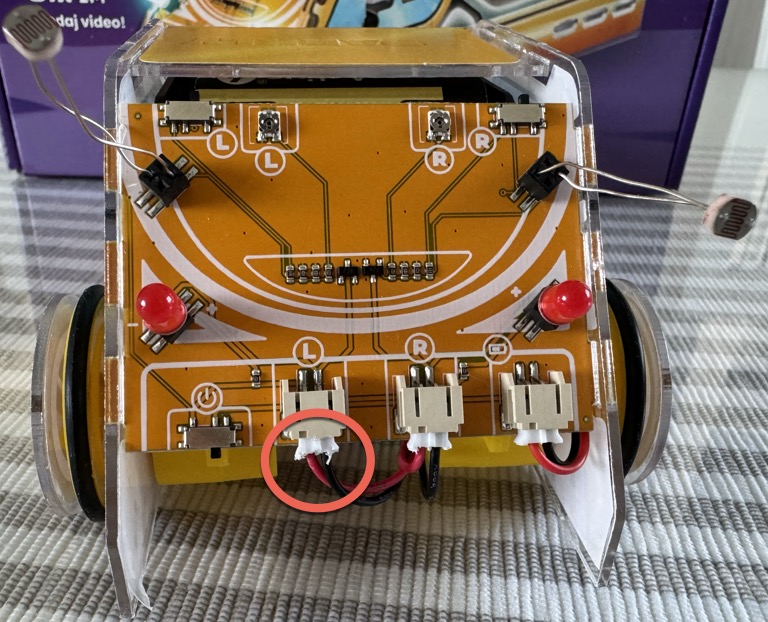
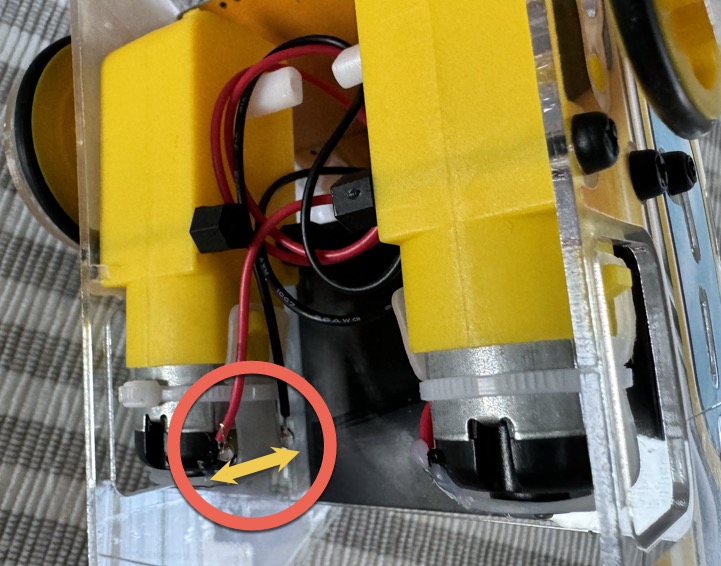
Here’s what happened: one wheel was rotating correctly, moving forward, but its counterpart was rebelliously spinning in the opposite direction, backward. Now, you may expect that these motors operate on direct current. The solution, in theory, was simple: reverse the polarity by swapping the + and – connections.

However, when I tried to switch the battery input, I hit a snag. The stubborn cable, as shown in the image, refused to budge:

Refusing to be defeated, I took a more hands-on approach. I unsoldered the black and red wires on the motor and then switched their positions.

And voilà, it worked! What seemed like a complicated problem turned out to have a pretty simple fix.

So, to all my fellow STEM enthusiasts and tinkerers, remember, sometimes the solution is just a wire swap away 🙂

Happy tinkering and happy holidays! 👋

Quick tips

How to edit an existing automatic top-up in Revolut?

Setting up an automatic top-up is simple because it’s offered as an option when you, well, top-up. However, editing an existing one is actually not as straightforward as one would expect (yes, Revolut UX team, I’m looking at you 🙂). So, in this very short post, I’ll show you how to edit an existing automatic top-up in Revolut.

First, in your Accounts tab click on the Add Money button:

Revolut - Add money

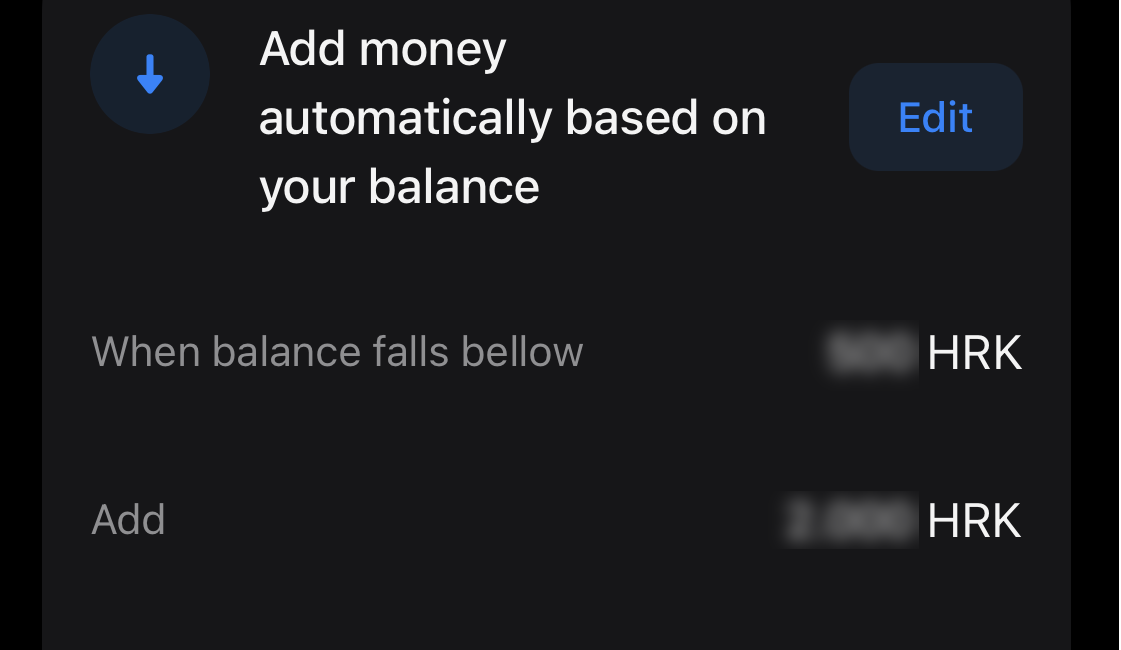
Second, click on this small icon on the right-hand side:

Revoluti - edit icon

Third, edit the amounts and hit Save:

And that’s it – hope you found this tip useful 💪

How to edit an existing automatic top-up in Revolut? https://t.co/JmmzP7pSbD @RevolutApp

— Nikola Brežnjak (@HitmanHR) January 21, 2022

Quick tips

How to prevent js beautify in Visual Studio Code to expand JSON objects

In this quick tip I’ll show you how simple it is to prevent js-beautify in Visual Studio Code to expand JSON object. Of course, for those who use js-beautify plugin in Visual Studio Code and don’t want to automatically expand their JSON objects that they may have (for a reason) inlined.

If you’re currently not utilizing the .jsbeautifyrc file, then first create it in the root directory of your project. After this, just put this content in it:

{
    "brace_style": "collapse-preserve-inline"
}

Restart VSC and that’s it. More information about this ‘issue’ can be found in the official bug thread on Github.

Hope this helps someone ?

How to prevent js beautify in Visual Studio Code to expand JSON objects https://t.co/mNuRjy7Xht

— Nikola Brežnjak (@HitmanHR) November 27, 2017

Page 1 of 51234»...Last »

Recent posts

  • Why You Should Start Blogging (Even If Nobody Will Read It)
  • Speed Reading
  • Impostor Syndrome
  • Why Strange Images Make You Remember Better
  • Productivity tip: rate things 1-10 without 7

Categories

  • Android (3)
  • Books (114)
    • Programming (22)
  • CodeProject (36)
  • Daily Thoughts (78)
  • DevThink (5)
  • Go (3)
  • iOS (5)
  • JavaScript (128)
    • Angular (4)
    • Angular 2 (3)
    • Ionic (61)
    • Ionic2 (2)
    • Ionic3 (8)
    • MEAN (3)
    • NodeJS (27)
    • Phaser (1)
    • React (1)
    • Three.js (1)
    • Vue.js (3)
  • Leadership (1)
  • Meetups (8)
  • Miscellaneou$ (84)
    • Breaking News (8)
    • CodeSchool (2)
    • Hacker Games (3)
    • Pluralsight (7)
    • Projects (2)
    • Sublime Text (2)
  • PHP (6)
  • Quick tips (44)
  • Servers (8)
    • Heroku (1)
    • Linux (3)
  • Stack Overflow (82)
  • Unity3D (9)
  • VibeCoding (2)
  • Windows (8)
    • C# (2)
    • WPF (3)
  • Wordpress (2)

"There's no short-term solution for a long-term result." ~ Greg Plitt

"Everything around you that you call life was made up by people that were no smarter than you." ~ S. Jobs

"Hard work beats talent when talent doesn't work hard." ~ Tim Notke

© since 2016 - Nikola Brežnjak