

FOMO as a Developer: You’re Not Behind, You’re Just Human
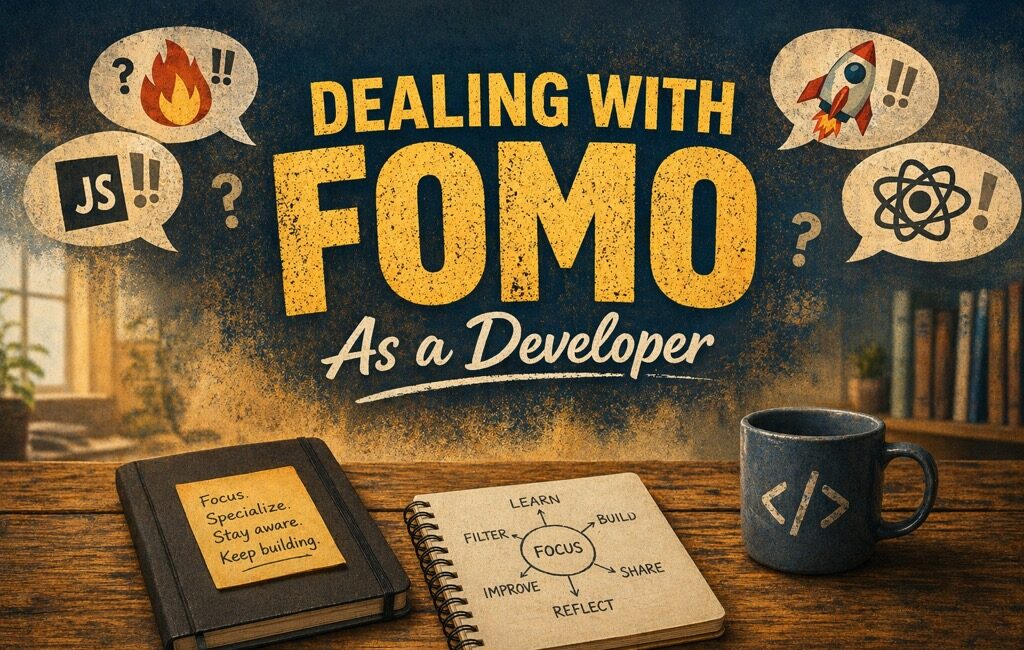
There’s a special kind of anxiety that comes as a bonus when working in tech.
A new framework drops.
A new AI tool shows up.
Someone posts a thread about the "only AI stack you need in 2026".
Your inbox politely reminds you that 67 unread newsletters are waiting.
And, just like that, you get that nagging feeling of falling behind.
This is known as FOMO a.k.a. the fear of missing out. Not the marketing kind, with fake countdown timers and "act now" nonsense, but the developer/knowledge_worker kind.
The one where you feel like if you don’t read everything, learn everything, and try everything, you’ll somehow become obsolete overnight.
There is already more to know than any one person can ever realistically learn, and more new stuff pops up every day than most of us could absorb in a month.
So, the tip is: accept that you can’t learn it all and instead discipline yourself to be intentional. What you’ll find is that you’ll become an expert in a few things vs. knowing a bit about everything (and, newsflash: LLMs do that better than you either way).
You should absolutely stay aware of what’s happening around you. If a whole platform shift is happening, it helps to at least know that it’s happening. But that doesn’t mean you need to immediately become an expert in every shiny new thing that lands on Hacker News. Being aware is good. Being consumed by it, not so much.
Stop treating every incoming newsletter or link dump as urgent. Batch it. Put it on a schedule. Read it later, when you decide to. And when you do, don’t open every single link like a caffeinated raccoon with ten browser tabs already screaming for mercy 🙈.
Instead, summarize, skim, filter.
Then, pick the two or three things that are actually relevant to your work or your curiosity right now.
Trying to follow everything across the current best model, AI tool, JS, Swift, Android, leadership, productivity, AI, databases, architecture, and whatever else is a guaranteed recipe for shallow overwhelm.
Narrowing your focus gives you something much more valuable: traction. You may never be "the best ~programmer~prompter in the world," but you can absolutely become exceptionally good in a smaller niche that matters to you. That’s where confidence starts replacing FOMO.
However, don’t become so narrowly specialized that you miss major shifts entirely. Being an amazing Lisp dev specializing in X, but totally neglecting the use of any AI coding aids is also not something you’d want to do blindly. You don’t need to master every new platform on day one, but you should at least know what exists, what it’s for, and why it matters. A few minutes of awareness can save you from being blindsided later. That’s a very sane approach, and honestly, probably the right one.
So if you’ve been feeling behind lately, here’s the reminder: you’re probably not.
You’re just living in an industry with an absurd rate of change, while also trying to do normal human things like work, think, rest, relationships, maybe even raising a family. The goal isn’t to know everything. The goal is to know what matters for you, right now, and keep moving.
That’s enough. More than enough, actually.
In case you’re more of an audio type, you can listen to this discussion here.
Full Transcript
Nikola: Hello, and welcome to another episode of the DevThink podcast with your hosts, Nikola and Shawn. In this episode, we’re going to talk about how to deal with FOMO.
For those of you who don’t know what FOMO is, it stands for fear of missing out. And as you’ve probably noticed, if you’re in this industry, every freaking day there’s something new. And not just in general, but across different fields too.
Take JavaScript, for example. Every now and then there’s a new framework. It’s crazy.
So let’s say you’re a very passionate person who wants to read about everything and test everything out. But here’s the thing: there are only 24 hours in a day. Sure, Beyoncé also has those same 24 hours, but hey, you also have to live, right?
So that brings us back to the question: how do you deal with FOMO, or fear of missing out? What would you say, Shawn?
Shawn: Well, I have a very negative connotation of FOMO because I associate it entirely with marketing.
You always get emails about limited-time offers, advertisements saying supplies are limited, "act now," "this deal only lasts until midnight next Tuesday," and so on. I recognize it for what it is, which is bullshit.
And so it actually makes me angry when I see it aimed at me, because I find it insulting to my intelligence. It’s counterproductive. If you give me a limited-time offer, it’s much more likely to make me not interested in your product than it is to make me take action right away.
Nikola: Interesting. Because you know that, of course, they’re going to repeat it. And if the sale goes well, they’re going to repeat it again.
Shawn: Right. Or it’ll be even cheaper a month later, depending on whether they made enough money that week.
Nikola: Okay, so now we know that this is not the kind of FOMO we’re talking about.
How do you deal with fear of missing out in the sense of: "Okay, I didn’t read my newsletter this week. I’m probably falling behind."
Shawn: I’ve long since resigned myself to the fact that there is more to know than I will ever know, and there’s probably more new stuff generated each day than I could learn in a week, or a month, or maybe even a year.
So I don’t let it bother me.
And as far as learning new things goes, you’re going to do that anyway because you’re interested, so that’s fine. And if it’s impossible for you to keep up with everything, then it’s impossible for anyone else to keep up with everything too.
It’s not like the next time you go looking for a job, all the other candidates are going to know literally everything that’s been on Hacker News for the last five years, while you only know 1% of it because you were busy living, working, maybe having a family, or even having a hobby… like a podcast or something.
Nikola: Okay. So here’s my take on it: specialize.
Don’t try to cover everything. Don’t try to cover every newsletter, every website, every single thing in JavaScript, Swift, Android, leadership… what else? How to fix a light bulb? I just made that one up.
What I’m trying to say is: if you really want to cover everything from a certain field, then specialize in that field. It’s going to be easier.
For example, let’s say you’re subscribed to JavaScript Weekly. Or Swift Weekly. Or whatever. When that email arrives, try to batch it so that you don’t read each and every email the moment it pops up in your inbox. We’ve talked about this before — it’s very distracting. It’s not the way to go.
So when you do sit down to read these — let’s call them FOMO emails — you’ll get better at sifting out what you actually want to read, instead of opening every freaking link in the email. Because that leads you down the path of no return.
You’ll start noticing, "Okay, I already know how to do this," so you skip it.
And if you do this on a weekly basis, this can be an investment of maybe half an hour to check out those links. You’ll probably only end up reading two, three, maybe five links a week.
Because yes, a lot of things come out. But then again… probably not that much that you truly need.
So if you set aside this FOMO time, so to speak, and read the links from that one newsletter, you’re going to be in good shape.
However, if you want to do this for every technology you’re even remotely interested in — forget it. You’re just not going to be able to do it.
You’re going wide and not actually going deep. Depending on where you are in your career, that may be okay. But I’d argue that if you really want to deal with FOMO, one of the things you can do is specialize a bit.
Shawn: Yeah, although I do think you should have as much width as possible, even if that just means spending a few seconds being familiar with what exists.
Because at some point, you may want to switch.
For example, if you were a programmer doing embedded C development for 25 years and you never paid attention to the rise of mobile development — iOS and Android — then you would have missed out on a huge opportunity.
So I’m not saying that the moment the iPhone is announced, you should go out and learn Objective-C, and the moment Android comes out, you should go learn Java and the SDK.
But know enough to know: here’s the platform, here’s the language it uses, here’s the SDK it needs, and here are its capabilities in general.
Can you make a game? Can you make a phone app? Can you make whatever it is you’re interested in?
And don’t spend hours on it. Spend minutes. Or even seconds.
Otherwise, I completely agree with what Nikola said. And just to expand on it: he likes to bring up James Clear; I like to bring up Seth Godin and The Dip, where he talks about specializing.
I don’t know if he uses that word exactly, but he says that if you can’t be the best in the world at something, you should just quit.
And of course you can never be the best, for example, "programmer" in general. But if you narrow the focus — like "I want to be the best iOS programmer for telecom apps" — now you’ve made yourself a much smaller niche to be the best at, and you have a much better chance of achieving that goal.
So yes, find your niche and work to be the best in it. Or quit and move on to another one.
But you may one day decide to leap to something else, and it would be really good not to be taken by surprise when either your niche disappears and goes out of style, or something else really cool comes along that you’d rather do.
Nikola: Excellent. Cool. In case, Shawn, you don’t have anything else to add, I think this is a wrap-up. I’ve said enough.
Shawn: Excellent.
Nikola: Well, dear guys, don’t listen to us. Go read some newsletters. FOMO!
Shawn: Yeah, we’re just making use of Cunningham’s Law. Don’t worry about it.
Nikola: Excellent. Okay, cool guys, this is it for this episode. Talk to you next time.
Shawn: Bye.
Thank you for listening to the DevThink podcast. You can contact us at [email protected].


Leave a Comment