

If only life had an XP bar
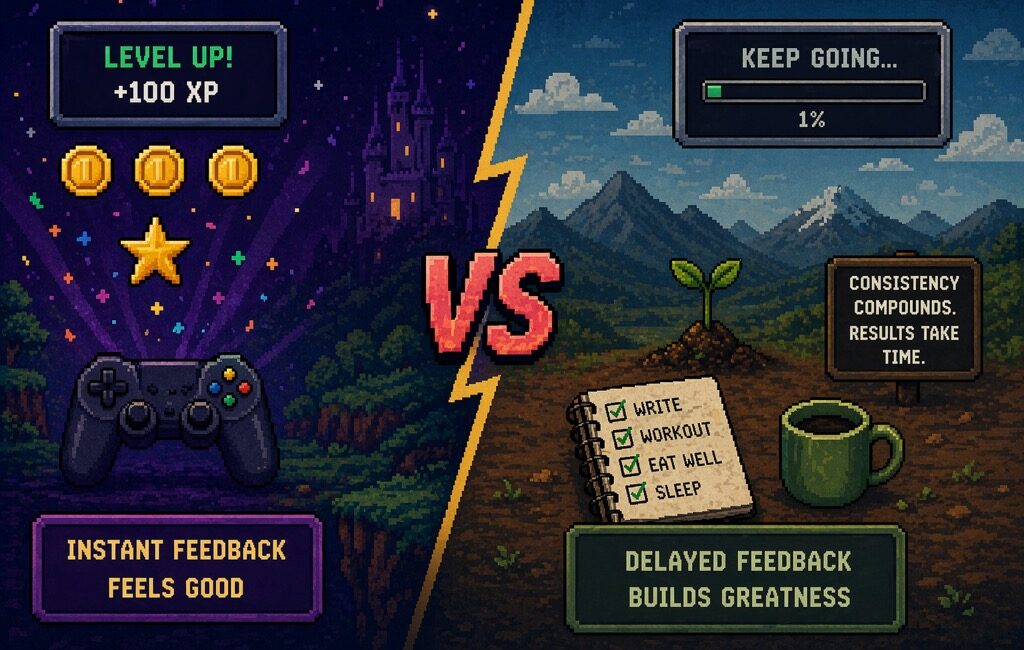
One of the reasons we struggle keeping up with good habits is that real life is terrible at giving us quick rewards.
If most worthwhile things in life are straightforward in theory, why is it so much easier to grind repetitive tasks in a video game than to do the same kind of repetition in real life? This conversation lands on a very practical answer: games are built around immediate feedback, while real life usually makes you wait.
The problem isn’t that success is complicated
A lot of the things we want are not mysterious nor rocket science (unless, OFC, you want to become a rocket scientist 🚀👨🔬).
If you want to write a book, you should write consistently.
If you want to get stronger, you should train consistently.
If you want to lose weight, you should make better food choices. Yes, consistently.
Simple? Often yes.
Easy? Not even close.
We usually don’t fail because we don’t know what to do. We fail because the reward for doing it well is delayed.
That’s where games (that are done well) flourish.
Why games are so good at keeping us hooked
James Clear talks about the fact that habits need to be appealing, and they need some kind of reward attached to them. Games do this brilliantly. You get progress quickly. You get visual feedback. You get points, levels, near-misses, small wins, dopamine hits… the whole buffet.
In a game, the loop is tight:
- do a thing
- get feedback
- feel progress
- do the thing again
In real life, the loop is more like this:
- do a thing
- wonder if it matters
- do a thing again tomorrow
- maybe see results in a month
- possibly question your entire existence in the meantime 🙈
That delay is brutal.
When you go to the gym for a week, you probably do not look dramatically different.
When you write for three days, you probably do not have a finished manuscript.
When you eat healthy for a few meals, you definitelly do not feel like a transformed human being.
But in a game? You killed the monster. You got the coins. You found a new cool armor. With 50%+ to luck! 🍀
No wonder the brain goes, "Ah yes, let’s do more of that."
The funny fake product idea that actually makes a solid point
So, here’s one crazy idea for solving weight loss with instant feedback: a fitness watch and shoes with built-in scales that constantly show your weight trend during the day. Eat dessert, see the spike. Skip it, get rewarded. Silly? Sure. But also kind of brilliant, because the joke hides a real truth: The faster the feedback, the easier it is to stay engaged.
And that’s the takeaway: we don’t always need more discipline. Sometimes we need a better feedback loop.
So what do we do in real life?
Tony Robbins (and most other folks in that genre of personal development) say something to the extent of: In life, we run away from pain and towards pleasure.
So, if you’re trying to build a habit, add a reward system to it. Make the behavior more appealing. Break the goal down. Give yourself small wins at specific points so the habit has a better chance of sticking.
That does not mean you need to turn your life into a productivity circus.
It just means you should stop expecting your brain to love a system that gives it no signal that progress is happening. Now, if you’re hardcore, you could just "TRUST THE PROCESS" and "know" the progress is going to come. But, for the rest of us, here are a few simple ways to apply that:
1. Make progress visible
Do not trust your motivation to remember invisible effort.
Track it.
A checklist, streak counter, habit app, wall calendar, notebook, whatever works. The medium matters less than the visibility.
If the reward is delayed, the proof of effort should not be.
2. Reward the process, not just the outcome
If your only reward comes at the finish line, you’ll quit long before that.
Instead of saying, "I’ll feel good when I lose 10/22 kilos/pounds," make the reward happen earlier:
- finish 5 workouts this week
- write 300 words today
- cook at home 4 nights in a row
You want your brain to associate satisfaction with showing up.
3. Lower the size of the loop
The shorter the cycle between action and acknowledgment, the better.
Do not wait a month to review progress on a habit you do daily. Review it daily. Even if the "review" is just checking a box.
Games don’t wait three weeks to tell you you did something right. Neither should you.
4. Stop demanding perfection
James Clear says that every action is a vote for the kind of person you want to become. If you slip once, that doesn’t erase the many votes you’ve already cast in the right direction. You do not need 100%. You need consistency. Even 90% done over time will produce results.
That’s such an important reminder.
People mess up once and suddenly act like the whole mission is over.
Ate badly once?
Missed one workout?
Skipped one writing session?
Okay. Cool. Welcome to being a human.
Cast the next vote well.
Then again, folks like Clayton Christansen will tell you it’s actually easier to do something 100% of the time than 98% of the time. YMMV.
The bigger takeaway
Something that took me a long time to realize is that We often lose not because our goals are wrong, but because our systems are bad at making progress feel real.
Games understand human behavior incredibly well. That’s why they’re compelling. The trick is not to complain about that. The trick is to borrow what works.
Build habits with better feedback.
Create visible progress.
Reward the right actions.
Accept imperfect consistency over imaginary perfection.
And voilà, suddenly real life stops feeling like the world’s worst-designed leveling system.
Full Podcast Transcript
Shawn: Hello, everyone, and welcome back to the DevThink podcast with your hosts, Shawn and Nikola.
Nikola: Yes.
Shawn: And Nikola, today it is a Q&A. One Q, one A, just like Kevin Smith. Alright.
So we all know what we have to do to accomplish a goal. If I want to write a novel, I should write some number of words a day. If I want to become more muscular, I need to work out a little bit each day. And if I want to lose weight, I need to eat a little less each day.
There are so many things that are so simple. And we’ve talked about the difference between simple and easy, right? A lot of things are really simple. It’s not easy to actually do it.
So why is it that the most boring, repetitive, mindless behavior is so easy for almost anyone to do if it’s in a video game, but not in real life?
Nikola: Awesome, awesome question. And here’s actually what I think about this.
As our favorite author, whom we had on the show, James Clear, said: you need to make it appealing, right? You also need to get some reward for it. And exactly that’s the thing that happens in video games.
Very early on, you’re just going and everything is flowing. You’re hitting everything. And just by the time it gets a little bit harder, again, you’re hit with some, let’s say, luck. You were just missed by, I don’t know, some rock that was falling and it just missed you.
So you basically get these kinds of accomplishments in. You hit the wall, but then you go past it and you get rewarded for that.
Imagine this, and mind you, this tends to happen in a very short amount of time. Compare that to muscle building, like you said before. Dude, you have to work very, very hard for a very long amount of time to actually see any progress. Whereas in the game, you see this progress almost immediately.
And that’s why we get so hooked. We’re searching for more of this immediate positive feedback, right? This positive feedback loop, which in life we sort of don’t get immediately. We get it after a book, after months and months of work, right?
So that’s why I would say that grinding in video games works so well. And actually, people who know this, and those who make awesome games know this, trust me. That’s why they make simple games like Candy Crush Saga. Why is this so popular? Because I would argue that they used this part very well. They made it appealing for people to say, "Hey, look, I achieved level 57."
Shawn: Right. Or whatever. I haven’t played the game. But yeah, that makes a lot of sense.
So based on that, I have an idea for an idea that’s going to make me a billionaire. I’m going to solve the world’s weight loss issue.
Nikola: Excellent. Thank you.
Shawn: Yeah. Yes? Instant feedback, right?
Invent a fitness watch along with fitness shoes where the shoes have scales in them and weigh you every second of the day. And on the watch, you see a downward graph of your weight loss, because every moment you’re not eating or drinking, you’re losing weight. So you can watch it go down throughout the day.
And when you eat that dessert, you see that spike. So you look at the dessert, you look at that line on your watch, and you say, "No. I’m not gonna do it." And you get bonus points or something like that.
Because as you said, if someone eats nothing but vegetables all day every day, or whatever it is it takes to lose the weight, it’s only at the end of maybe a week that they step on the scale and get that boost. Whereas in a video game, it’s the same within a second that you get that reward.
Nikola: Yes. Awesome idea. Hey, awesome idea.
Actually, I think I saw somewhere that they made a product like a fork, which as you eat with it, it counts your calories in a way. I honestly don’t know if I saw this as a joke or if it’s a real thing, but that as well.
And I actually joked that humans version 1.2 or 2.0 will come with an ingrained updated operating system that will disallow you from putting in more food than your body is actually able to process. But as I said, 2.0.
Shawn: Excellent. And we could take that extra food that fat people aren’t eating and use that to end world hunger. Problem solved.
Nikola: Now you’re talking Star Trek kind of stuff.
Shawn: Right. Alright. So that’s the question answered. Shawn, do you have anything you want to add to that?
Nikola: I would actually add this: I started reading James’s book. It arrived a few days ago. And here’s the thing. You have your habits, right? And now you know that for a new habit to form successfully, you have to have this reward system set in.
So think about it. Whatever habit you’re trying to build, try to add this reward system as well. Because with this, the probability for it to stick is higher. That’s all.
So break down whatever you’re trying to achieve and give yourself this reward every now and then, but at a specific moment, because that’s going to reinforce the habit.
Shawn: Yes. And remember that you will not be perfect. Every time you stray from perfection, do not say, "Oh, that’s it. I failed now."
As James put it, you cast one vote for being the kind of person that you don’t want to be, but you’ve probably cast 10 or 15 or 20 votes for being the person you want to be. So if you did the right thing 90% of the time, just keep doing that. You don’t have to hit 100%. Do 90 consistently, and you’ll see results.
Nikola: Exactly.
Shawn: Awesome. So that’s all that we’ve got for you guys today, and talk to you next time.
Nikola: Bye, everybody.
Shawn: Thank you for listening to the DevThink podcast. You can contact us at [email protected].



Leave a Comment